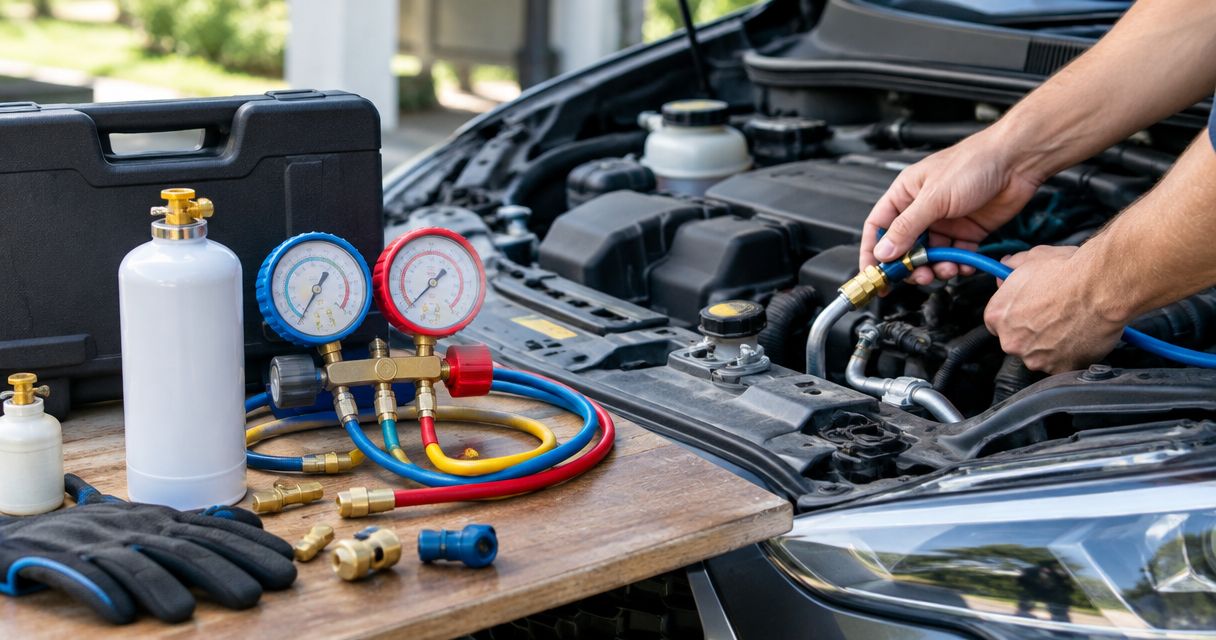
Best overall for a confirmed R-134a top-up: a sealant-free kit with a reusable gauge and hose. Best for an occasional R-134a task: a basic gauge-equipped kit. Best for an R-1234yf vehicle: a dedicated, compatible kit—but only after diagnosis. This 2026 guide ranks kit types by compatibility, useful controls, and the limits of DIY car AC repair.
- The best ac recharge kits for diy car ac repair match the vehicle’s refrigerant and exclude stop-leak additives.
- A reusable R-134a gauge-and-hose kit is the default choice only after a low-charge condition is confirmed.
- R-1234yf vehicles require compatible equipment; adapters do not make another refrigerant suitable.
- Elite Auto Repair & Service Inc provides car AC repair for Kissimmee drivers who need diagnosis rather than a top-up.
Why this matters
An AC recharge kit adds refrigerant; it does not diagnose why your car stopped cooling. Warm air can come from a refrigerant leak, an electrical fault, a compressor problem, or an airflow restriction. Adding refrigerant addresses none of those causes by itself.
Elite Auto Repair & Service Inc is best for Kissimmee drivers who need car AC repair rather than an unverified refrigerant top-up. The shop offers AC repair and diagnostics; visit Elite Auto Repair & Service Inc when you need the cause identified before choosing a repair.
A sealed AC system does not consume refrigerant like an engine consumes fuel. If the charge is low, investigate where refrigerant escaped. Repeatedly adding cans turns an unresolved problem into a recurring task.
What makes the best AC recharge kits for DIY car AC repair?
For a 2026 purchase, judge the equipment before judging its packaging. These criteria separate a useful tool from a can that encourages guesswork:
- Refrigerant compatibility: The kit, refrigerant, and vehicle label must agree. R-134a and R-1234yf are not interchangeable.
- Sealant-free contents: Choose refrigerant without stop-leak additives unless the vehicle manufacturer’s service information specifically authorizes them.
- Useful measurement: A readable gauge helps observe pressure, but a low-side reading does not measure the total refrigerant charge.
- Controlled connection: The correct coupler, sound hose, and controllable valve matter more than promotional claims on the package.
- Vehicle-specific instructions: Follow the manufacturer’s refrigerant specification, charge information, and service precautions—not a universal target on a dial.
- Honest limitations: A good kit does not promise to repair compressor faults, remove moisture, or solve every cause of warm air.
Check the underhood AC label before shopping. Do not infer the refrigerant from the vehicle’s appearance, the weather, or the fact that another car uses a particular can.
AC recharge kit types at a glance
These 2026 picks rank equipment categories, not interchangeable products. A kit earns its place only when its refrigerant and intended use match your vehicle.
| Rank and kit type | Best for | Standout feature | Key limitation |
|---|---|---|---|
| Reusable R-134a gauge-and-hose kit | A confirmed R-134a top-up with reusable equipment | Separates the reusable connection equipment from the refrigerant container | Low-side pressure alone cannot establish the correct charge |
| Basic R-134a gauge-equipped kit | An occasional, confirmed R-134a task | Combines a simple gauge and dispensing connection | Gives limited diagnostic information |
| Dedicated R-1234yf recharge kit | A confirmed R-1234yf application | Uses equipment intended for that refrigerant | Compatibility does not eliminate handling or diagnostic requirements |
| Refrigerant-specific manifold gauge set | Trained users carrying out broader AC diagnosis | Measures high-side and low-side pressure | Is not a complete recovery, evacuation, and charging setup |
1. Reusable R-134a kit: best for reusable top-up equipment
A reusable R-134a gauge-and-hose kit connects compatible refrigerant containers to the vehicle’s low-side service port. It lets you keep the connection equipment rather than treating the entire assembly as disposable.
Best for: An owner whose vehicle uses R-134a and whose low-charge condition has already been assessed. Reusability is the reason this category ranks first—not an ability to diagnose every AC fault.
Reusable R-134a kit pros:
- Keeps the gauge and hose available for later compatible tasks.
- Allows you to choose sealant-free refrigerant separately when the equipment supports the container.
- Provides a pressure reading instead of dispensing blindly.
- Gives you a connection and valve to inspect before use.
Reusable R-134a kit cons:
- A low-side gauge cannot tell you the exact mass of refrigerant already in the system.
- The hose, seals, coupler, and container connection still require inspection.
- Reusable equipment can encourage repeated top-ups instead of leak repair.
Read the refrigerant container and hose instructions together. Container connections and valve arrangements differ; a reusable hose is not automatically compatible with every can labeled R-134a.
Verdict: Buy only for a confirmed R-134a task. Skip it as a shortcut around diagnosis.
2. Basic R-134a kit: best for an occasional confirmed top-up
A basic R-134a kit combines a refrigerant container with a dispensing connection and gauge. Its appeal is a simpler equipment choice for a driver who does not need a separate reusable setup.
Best for: An occasional R-134a task after the vehicle’s requirements and cooling fault have been checked. Choose this category for simplicity, not because a colored gauge band guarantees correct charging.
Basic R-134a kit pros:
- Brings the dispensing components together in one package.
- Reduces the need to select a separate hose and gauge.
- Provides a visible low-side pressure reading.
Basic R-134a kit cons:
- The gauge provides only a limited view of system operation.
- Package convenience does not establish refrigerant compatibility.
- Included additives require careful label checking.
Do not mistake a gauge’s green area for proof that the system contains the correct charge. Pressure changes with operating conditions, and a reading needs context. The vehicle’s specified refrigerant mass remains the charging reference.
Before buying, read the full contents description. A product described as a recharge kit can include oil, dye, or sealant in addition to refrigerant. Those additions are not automatically appropriate for your car.
Verdict: Buy for an occasional confirmed R-134a task; skip packages with unsuitable additives.
3. Dedicated R-1234yf kit: best for confirmed refrigerant compatibility
A dedicated R-1234yf kit uses connections and components intended for an R-1234yf system. It belongs on this list because matching the vehicle’s refrigerant takes priority over the convenience of an R-134a kit.
Best for: An R-1234yf vehicle when the service information permits the intended procedure and a low-charge condition has been confirmed. Treat compatibility as the starting requirement, not approval to add refrigerant without diagnosis.
Dedicated R-1234yf kit pros:
- Matches the refrigerant specified for an R-1234yf system.
- Uses a connection arrangement intended for that application.
- Avoids treating an R-134a kit as a universal solution.
Dedicated R-1234yf kit cons:
- R-1234yf is mildly flammable and requires appropriate handling precautions.
- A correct connector still cannot identify a leak or compressor fault.
- Vehicle-specific equipment and service requirements remain important.
Keep refrigerant work away from ignition sources and follow the product’s safety instructions. Do not use adapters to substitute a different refrigerant or defeat incompatible connections.
Hybrid and electric vehicles deserve particular care. Compressor oil specifications and electrical safety requirements can differ from conventional systems. Follow the exact vehicle procedure rather than assuming an ordinary recharge package is suitable.
Verdict: Wait until compatibility, diagnosis, and handling requirements are confirmed.
4. Manifold gauge set: best for trained AC diagnosis
A refrigerant-specific manifold gauge set connects to the high-side and low-side service ports. It gives a trained user more operating information than a low-side-only recharge gauge.
Best for: Someone with AC service knowledge who needs to evaluate pressures as part of a vehicle-specific diagnostic procedure. This is diagnostic equipment, not a beginner-friendly answer to warm air.
Manifold gauge set pros:
- Shows pressure on both sides of the operating system.
- Supports more detailed diagnosis than a single low-side gauge.
- Separates the measurement equipment from a packaged recharge can.
Manifold gauge set cons:
- Incorrect connections or valve operation introduce additional risk.
- Pressure readings require interpretation alongside temperatures and operating conditions.
- The set does not replace recovery equipment, a vacuum pump, or charge measurement equipment.
A manifold set alone cannot remove refrigerant safely, evacuate a system, and refill it to specification. Buying more gauges does not turn a top-up into a complete repair.
Avoid opening high-pressure connections without the proper procedure and equipment. Pressurized refrigerant can injure your eyes and skin, and intentional refrigerant venting is prohibited under federal rules.
Verdict: Buy for trained diagnostic use. Skip as your first DIY recharge purchase.
Before you connect a recharge kit
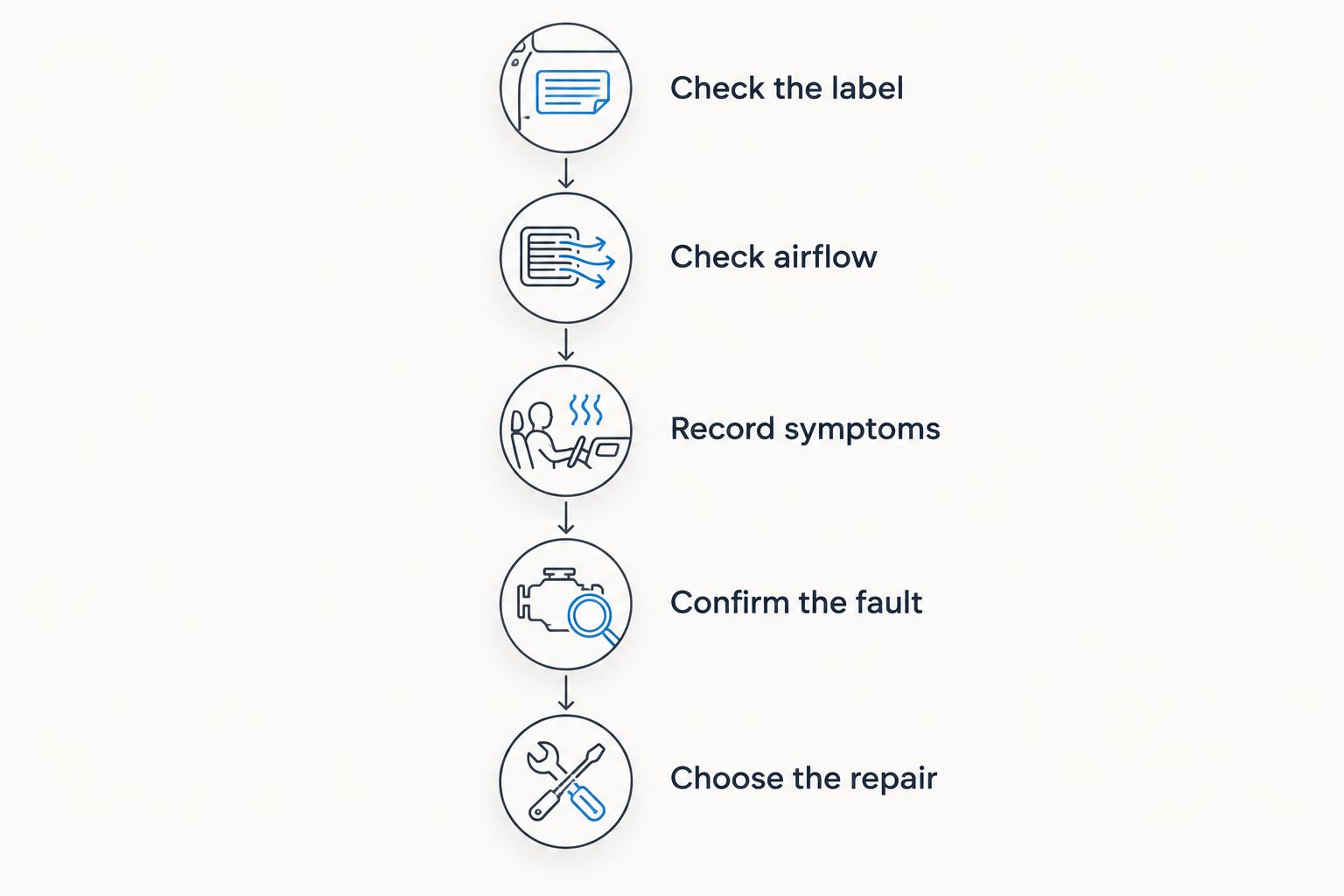
Use this decision sequence before a 2026 recharge attempt. It helps separate a plausible refrigerant issue from a problem a can cannot fix.
- Check the label: Identify the specified refrigerant and read the vehicle’s service requirements.
- Check airflow: Distinguish weak airflow from normal airflow that is not cold. A recharge does not clear a restricted cabin filter or repair a blower fault.
- Record symptoms: Note when cooling changes, whether the problem appeared suddenly, and whether the system has needed previous top-ups.
- Confirm the fault: Establish whether low charge is actually the issue before adding refrigerant.
- Choose the repair: Address leaks or failed components, then restore the charge using the appropriate procedure.
If cooling repeatedly disappears after a top-up, stop adding refrigerant and arrange a leak assessment. If the system is empty, or a component has been replaced, a consumer can-and-gauge kit is not a substitute for the required service procedure.
Elite Auto Repair & Service Inc offers car AC repair and diagnostics in Kissimmee, FL. Bring a clear description of the symptoms and mention any refrigerant, oil, dye, or sealant previously added.
Get your car AC checked
Visit Elite Auto Repair & Service Inc for AC repair and diagnostics in Kissimmee, FL.
How these kit types are ranked
The ranking prioritizes refrigerant compatibility, sealant-free contents, useful measurement, connection control, and clear limitations. Reusable R-134a equipment takes the default slot for a confirmed R-134a task because it separates the reusable tool from the refrigerant container.
The basic kit serves occasional use. The R-1234yf category serves a different refrigerant application. The manifold set serves trained diagnosis rather than a simple top-up. No category wins by claiming to fix every AC problem.
Which AC recharge kit should you choose?
For 2026, choose a sealant-free, reusable R-134a gauge-and-hose kit only when your vehicle uses R-134a and a top-up is appropriate. Choose dedicated R-1234yf equipment only for a confirmed compatible application. Do not buy a manifold set simply because it looks more complete.
If you have not established why the air is warm, choose diagnosis first. Elite Auto Repair & Service Inc provides AC repair for Kissimmee drivers who need help distinguishing a refrigerant problem from an airflow, electrical, or component fault.
FAQ
What are the best AC recharge kits for DIY car AC repair in 2026?
The best choice for a confirmed R-134a top-up is a compatible, sealant-free kit with a reusable gauge and hose. An R-1234yf vehicle requires dedicated compatible equipment. Diagnose the cooling problem before adding refrigerant.
Is a reusable recharge kit better than a basic can-and-gauge kit?
A reusable kit is better when you want to retain the gauge and hose for compatible tasks. A basic kit offers a simpler packaged option for occasional use. Neither determines the system’s exact refrigerant charge from low-side pressure alone.
Can I use R-134a in a car that requires R-1234yf?
No, do not substitute R-134a for R-1234yf. Use the refrigerant specified on the vehicle’s AC label and follow its service information. An adapter does not make the substitution appropriate.
Will an AC recharge kit fix a refrigerant leak?
A recharge kit does not repair the underlying leak. Added refrigerant can restore cooling temporarily when low charge is the cause, but the leak remains. Repeated loss of cooling calls for leak diagnosis and repair.
Should I buy an AC recharge kit with stop-leak?
Choose a sealant-free kit unless the vehicle manufacturer’s service information specifically authorizes the additive. Stop-leak is not a substitute for finding and repairing a leak. Tell your repair shop about any additives already used.
How much does professional car AC repair cost?
Car AC repair cost depends on the diagnosed fault and the work required. A recharge, leak repair, electrical repair, and compressor replacement involve different work. Ask for an estimate after diagnosis rather than comparing a refrigerant can with an unknown repair.
Does a green recharge gauge mean my AC is correctly charged?
No, a green gauge band does not prove that the refrigerant charge is correct. Pressure depends on operating conditions and system behavior. Follow the vehicle’s specified charging procedure rather than relying on a color alone.
Where can I get car AC repair in Kissimmee, FL?
Elite Auto Repair & Service Inc offers car AC repair and diagnostics in Kissimmee, FL. Describe the cooling symptoms and disclose any refrigerant or additives already put into the system. Visit the shop for help identifying the cause.
One last thing
Weak airflow and warm airflow are different complaints. Before buying refrigerant in 2026, describe which one you have. A cabin filter or blower problem needs an airflow repair, while normal airflow without cooling needs a different diagnostic path.
Keep the packaging from anything added to the AC system. Giving the next technician the exact contents is more useful than saying the system received a recharge.