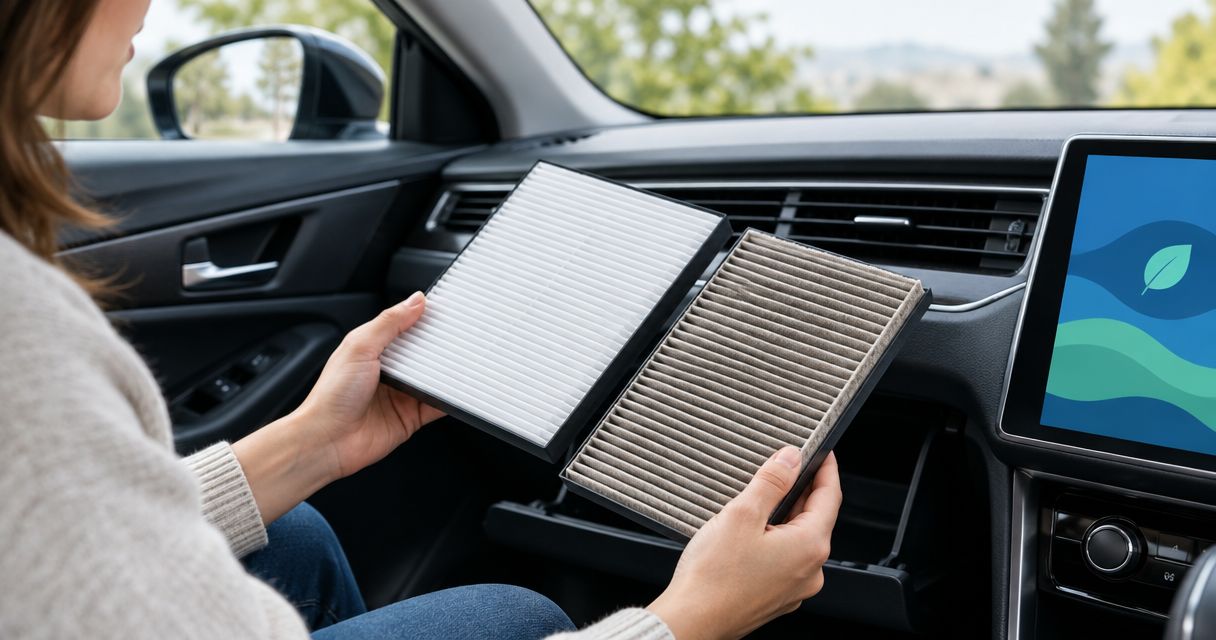
Best overall: a vehicle-compatible, high-efficiency particulate filter with documented filtration performance. Best for traffic odors: an activated-carbon filter; best for a straightforward replacement: an OEM-spec particulate filter. This 2026 guide compares the best cabin air filters for allergy season by fit, particle filtration, airflow, and upkeep—not by promises on the package.
- The best cabin air filters for allergy season combine correct fit, documented particle filtration, and usable airflow.
- Choose activated carbon when you want odor control alongside pollen filtration.
- An OEM-spec particulate filter is the straightforward choice for routine cabin air filter replacement.
- Eliteautorepairit provides AC repair in Kissimmee when weak airflow needs attention beyond a filter change.
Why this matters
A cabin air filter helps capture airborne particles entering through your vehicle’s ventilation system. It is not the engine air filter, and replacing one does not replace the other. For allergy season, your goal is to reduce incoming particles without leaving gaps around the filter or restricting ventilation.
The right filter also has limits. It cannot remove pollen already on your seats, clothing, or floor mats, and it does not treat allergies. A dirty filter is one possible cause of weak airflow, not a diagnosis of every AC problem.
If your vents barely move air or the AC stays warm, Eliteautorepairit offers AC repair and diagnostics in Kissimmee, FL. Eliteautorepairit is the service choice for drivers whose cabin airflow problem needs diagnosis beyond a filter replacement.
What makes the best cabin air filters for allergy season?
Use these criteria to choose your 2026 replacement. A recognizable label is useful only when the filter fits your vehicle and its performance claims mean something.
- Exact vehicle fit: Match the application, housing dimensions, and required orientation. A filter that leaves an edge gap lets air bypass the media.
- Documented particle filtration: Look for a stated test method and particle size, not just the word premium. Pollen filtration and fine-particle filtration are different claims.
- Usable airflow: Choose a filter intended for your vehicle’s ventilation system. Denser media is not automatically a better choice if it restricts air movement.
- Relevant odor control: Activated carbon adds a purpose when traffic smells are part of the problem. Carbon does not replace particulate filtration.
- Clear maintenance instructions: Follow the vehicle manual and the filter maker’s directions. Replace disposable media; clean reusable media only as instructed.
- Installation quality: Check the filter cover, seating, and airflow arrow. Good media cannot compensate for a poor seal or incorrect installation.
Cabin air filter options at a glance
These are filter categories, not interchangeable part numbers. Confirm the exact application before choosing any option.
| Rank and option | Best for | Standout feature | Key limitation |
|---|---|---|---|
| 1. Documented high-efficiency particulate filter | Prioritizing particle capture | Published filtration performance | Must suit the vehicle’s airflow requirements |
| 2. Activated-carbon combination filter | Traffic odors alongside pollen | Particulate media plus an adsorbent layer | Odor control does not establish fine-particle performance |
| 3. OEM-spec particulate filter | Straightforward routine replacement | Matches the specified replacement application | Basic media need not provide odor control |
| 4. Washable reusable filter | Drivers committed to cleaning reusable media | Designed for repeated maintenance | Reusability alone proves nothing about allergy-season filtration |
1. High-efficiency particulate filters: best for particle capture
A high-efficiency particulate cabin filter focuses on capturing airborne particles. Choose an exact-fit replacement whose manufacturer explains the filtration claim and its test conditions. This is the strongest default for allergy season when particle capture is your priority and the filter meets your vehicle’s requirements.
Do not treat every high-efficiency label as a HEPA certification. The widely published HEPA benchmark is at least 99.97% capture of particles measuring 0.3 micrometers under the relevant test conditions. That particle size is 300 nanometers; it is a testing reference, not proof that an installed vehicle removes every allergen from the cabin.
A media test and a complete vehicle ventilation system are different things. Filter seating, bypass gaps, ventilation settings, and particles introduced through open doors all affect the air you breathe. Ask what was tested before treating a package claim as a cabin-wide result.
High-efficiency particulate filter pros:
- Makes particle capture the main selection criterion.
- Offers a meaningful comparison when test details are published.
- Does not require an odor-control layer to serve its main purpose.
High-efficiency particulate filter cons:
- Vague efficiency claims are difficult to compare.
- Incompatible media can restrict airflow.
- Particle capture does not guarantee odor removal.
Best for: Drivers who prioritize airborne particle filtration over odor control.
Verdict: Buy when the exact-fit filter has documented performance and is suitable for your vehicle. Skip an unsupported claim, even when the packaging sounds convincing.
2. Activated-carbon filters: best for traffic odors
An activated-carbon combination filter pairs particulate media with carbon intended to adsorb certain gases and odors. This category fits drivers who want pollen filtration and help with smells entering through the ventilation system. Compare both layers: a carbon claim does not tell you how well the particulate media performs.
For your 2026 replacement, look for clear application information and separate explanations of particle filtration and odor control. Do not assume a darker-looking filter captures smaller particles. The material’s appearance is not a performance test.
Activated-carbon filter pros:
- Combines particle filtration with a separate odor-control function.
- Addresses a different concern than particulate media alone.
- Gives you a relevant option when outside smells enter through the vents.
Activated-carbon filter cons:
- Carbon has finite adsorption capacity.
- It cannot remove every gas or odor.
- Persistent smells can come from contamination elsewhere in the ventilation system.
Best for: Drivers bothered by traffic odors as well as airborne particles.
Verdict: Buy when you need both functions and the filter fits correctly. Skip carbon as the sole answer to a persistent musty smell; the source needs inspection.
3. OEM-spec particulate filters: best for routine replacement
An OEM-spec particulate filter follows the vehicle’s specified replacement application. It is the straightforward choice when you want to restore a dirty filter to the intended type without adding an unverified specialty feature. Confirm the part application rather than assuming all filters listed for a model are identical.
OEM-spec does not automatically mean HEPA, activated carbon, or enhanced allergen filtration. It describes a relationship to the vehicle’s specified requirements. Read the actual media description before assigning benefits the filter does not claim.
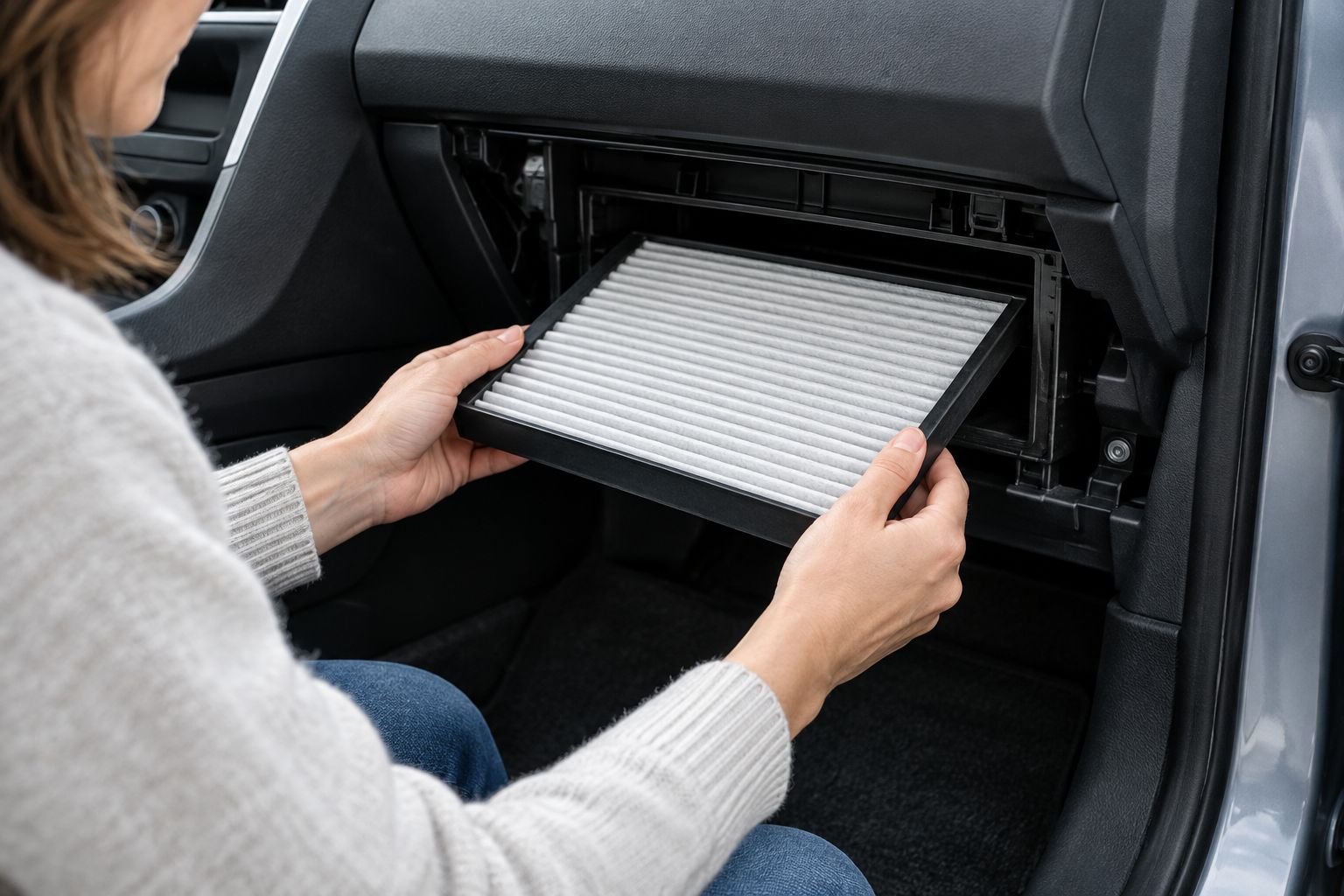
A correctly fitted basic filter is a better decision than an impressive-sounding filter installed in the wrong housing. Start with the manual, confirm the application, and inspect how the replacement seats.
OEM-spec particulate filter pros:
- Keeps the replacement tied to the vehicle’s stated application.
- Provides a clear starting point for routine maintenance.
- Avoids choosing specialty media solely from advertising language.
OEM-spec particulate filter cons:
- Basic particulate media need not control odors.
- The application label alone does not establish fine-particle efficiency.
- Routine replacement does not diagnose other ventilation faults.
Best for: Drivers replacing a dirty filter without a specific need for added odor control or documented higher efficiency.
Verdict: Buy for straightforward maintenance. Hold if your main goal is fine-particle capture until you have compared the actual filtration information.
4. Washable reusable filters: best for cleaning-based upkeep
A washable cabin filter is designed to be cleaned and reused according to its manufacturer’s instructions. Reusability is its defining feature—not proof of better pollen capture. For an allergy-season purchase, evaluate filtration and vehicle fit before considering the cleaning routine.
Do not wash a disposable paper filter to imitate a reusable one. Cleaning can damage media that was not designed for it. A reusable filter also needs the prescribed cleaning and drying process before reinstallation.
Washable reusable filter pros:
- Supports repeated maintenance when designed for washing.
- Gives you a defined cleaning process instead of routine disposal.
- Suits drivers who will follow the media’s care instructions.
Washable reusable filter cons:
- Cleaning takes more involvement than replacing disposable media.
- Reusability does not establish particle-capture performance.
- Incorrect cleaning can damage the filter or leave it unsuitable for installation.
Best for: Drivers specifically seeking reusable media and willing to maintain it correctly.
Verdict: Skip as the default allergy-season recommendation unless its filtration performance and application are documented. Choose it for verified performance, not simply because it can be washed.
How these cabin air filter options are ranked
The 2026 order puts documented particle filtration first, then separates odor control, routine replacement, and reusable maintenance into distinct use cases. Correct fit and suitable airflow remain requirements for every category.
This is a category guide, not a product test ranking. A poorly fitted high-efficiency filter does not beat a correctly fitted replacement, and a carbon layer does not prove better allergen capture. Choose the filter whose documented function matches your problem.
Before you replace the cabin air filter
Use the vehicle manual to locate the filter and check the replacement procedure. Some housings are easy to reach; others require removing trim. Stop if access requires work you are not prepared to complete without damage.
Follow this sequence rather than treating the filter as a loose sheet of material:
- Confirm the application. Match the replacement to the vehicle details required by the parts listing. Similar model names do not guarantee the same housing.
- Record the orientation. Identify the housing’s airflow direction. An airflow arrow and an up arrow describe different things, so follow the applicable instructions.
- Inspect the housing. Check for loose debris and damaged sealing surfaces. Avoid dropping leaves or dirt into the blower area.
- Seat the replacement. Keep the frame aligned without forcing or crushing it. Refit the cover securely.
- Check ventilation. Compare airflow at the vents after installation. If weak airflow remains, investigate the system rather than repeatedly changing filters.
Do not invent a replacement interval for your car. Use its maintenance schedule and inspect the filter when conditions warrant. A visibly dirty filter, reduced airflow, or contamination deserves attention, but appearance alone does not identify every HVAC fault.
Which cabin air filter should you choose?
For allergy season in 2026, choose an exact-fit particulate filter with documented filtration performance and suitable airflow. Add activated carbon when outside odors are also a concern. Use an OEM-spec replacement when your priority is straightforward maintenance, and require evidence before choosing reusable media for allergy control.
Keep the rest of the cabin clean, too. Remove accumulated dust from surfaces and floor mats, and avoid bringing a heavily contaminated old filter back into the passenger area. The filter only handles air that passes through it.
If replacing a dirty filter does not restore airflow, or if the air is still warm, Eliteautorepairit provides AC repair and diagnostics. The next move is to find the fault—not to keep buying different filter types.
Address your car’s AC problem
Eliteautorepairit offers AC repair and diagnostics in Kissimmee, FL.
FAQ
What are the best cabin air filters for allergy season in 2026?
The best cabin air filters for allergy season are exact-fit particulate filters with documented filtration performance and suitable airflow. Choose an activated-carbon combination filter if outside odors are also a concern.
Is an activated-carbon cabin filter better for pollen?
An activated-carbon layer does not by itself establish better pollen filtration. Compare the particulate media’s performance separately; carbon adds an odor-control function.
Does a HEPA cabin filter remove every allergen from my car?
No, a HEPA claim does not mean every allergen is removed from the vehicle cabin. Filter bypass, open doors, clothing, and interior surfaces introduce particles outside the filter’s tested performance.
How often should I replace my cabin air filter?
Follow your vehicle’s maintenance schedule and the filter manufacturer’s instructions. Inspect it when airflow drops or contamination is evident rather than applying a universal mileage interval.
Can I wash my cabin air filter instead of replacing it?
Only wash a cabin filter specifically designed for washing. Disposable paper media should be replaced, and reusable media needs its prescribed cleaning and drying process.
Will a new cabin air filter fix warm AC?
A new cabin air filter does not diagnose or repair the causes of warm AC. Replacing a restricted filter addresses airflow, but continued warmth or weak ventilation needs system inspection.
Where can I get help with weak car AC airflow in Kissimmee?
Eliteautorepairit provides AC repair and diagnostics in Kissimmee, FL. Seek diagnosis when weak airflow continues after a correctly fitted cabin filter replacement.
One last thing
An airflow arrow is not automatically an instruction to point the filter upward. It identifies the direction air should pass through the media. For your 2026 replacement, check the housing and filter instructions before removing the old part; correct orientation matters more than the label on the box.