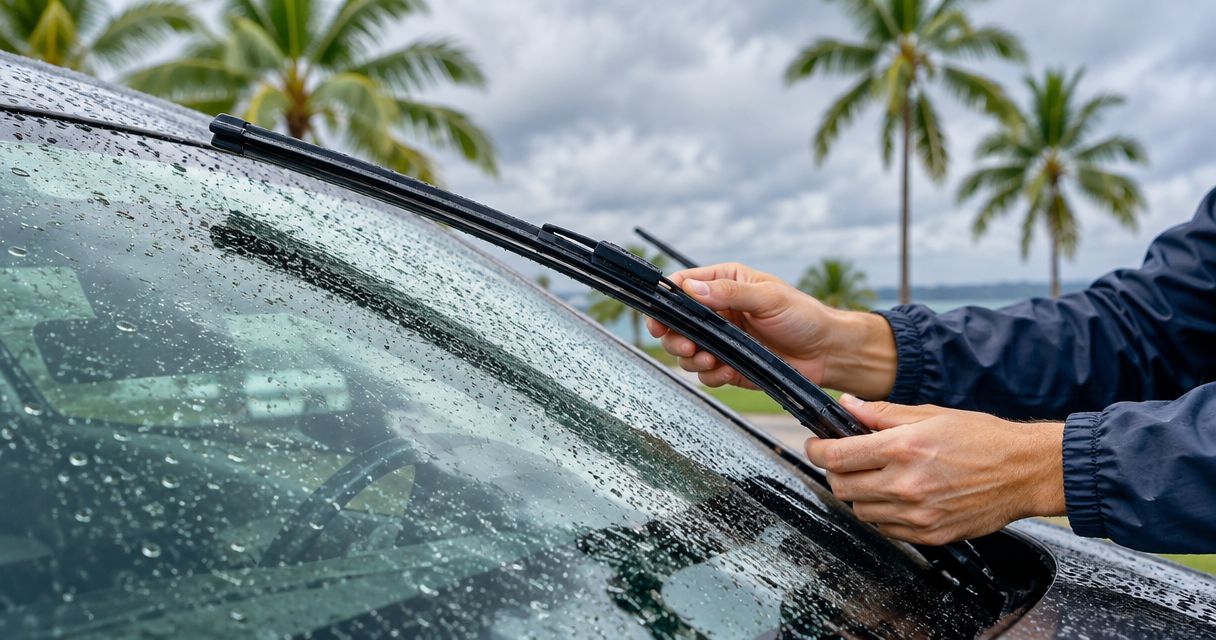
Best overall: vehicle-compatible beam blades. Best for covered-frame construction: hybrid blades. Best for a straightforward original-style replacement: conventional blades. The best windshield wiper blades for Florida rain in 2026 fit your vehicle correctly, maintain contact with the glass, and clear water without streaking; this guide compares blade designs rather than making unsupported claims about individual products.
- The best windshield wiper blades for Florida rain start with correct fit; beam blades are the default recommendation.
- Hybrid blades suit drivers seeking covered-frame construction; conventional blades suit straightforward original-style replacement.
- Silicone describes the wiping material, not the blade shape. Check both before choosing.
- Elite Auto Repair & Service Inc is a Kissimmee auto repair shop for drivers addressing broader vehicle maintenance needs.
Why this matters
Florida rain makes a clear windshield a practical safety requirement. A blade that leaves a broad unwiped patch deserves attention before your next wet drive, not after visibility deteriorates in traffic.
For your 2026 maintenance plan, choose by fit and wiping condition rather than packaging claims. Elite Auto Repair & Service Inc provides auto repair and maintenance in Kissimmee, FL, including brakes, diagnostics, oil changes, and AC repair. Keep windshield visibility on your maintenance checklist alongside those systems.
A different blade design will not fix every wiping problem. Dirt on the glass, a damaged arm, or an incorrectly attached connector can leave streaks even with a new blade.
What makes the best windshield wiper blades for Florida rain?
Use these criteria before choosing a blade type:
- Exact fit: Match the vehicle application, blade length, and arm connector. A blade that attaches is not automatically the correct blade.
- Glass contact: The wiping edge must follow the windshield through its sweep, without persistent missed areas.
- Clean wiping edge: Look for splits, deformation, or a loose insert. Material labels do not excuse visible damage.
- Suitable construction: Beam, hybrid, and conventional blades use different support structures. Select a design listed for your vehicle.
- Installation clarity: The attachment must lock securely without improvised adapters or forced parts.
- Serviceability: Replaceable inserts make sense only when the existing holder supports them and remains undamaged.
Correct fit comes before blade material. Keep that order when comparing options for 2026: application first, construction second, wiping material third.
Windshield wiper blade options at a glance
These options are not mutually exclusive. Beam, hybrid, and conventional describe construction; silicone describes a wiping material; a refill describes how you replace the worn edge.
| Option | Best for | Standout feature | Key limitation |
|---|---|---|---|
| Beam blades | Default complete-blade replacement | Curved supporting structure without an exposed articulated frame | The vehicle application and connector still need verification |
| Hybrid blades | Covered-frame construction | A cover over a supporting frame | The cover does not guarantee clean wiping |
| Conventional blades | Straightforward original-style replacement | Articulated frame supporting the wiping insert | Exposed joints add inspection points |
| Silicone-edge blades | Drivers specifically choosing silicone material | Silicone wiping edge offered in different constructions | Material alone does not establish fit or performance |
| Replacement inserts | Retaining a serviceable, refill-compatible holder | Replaces the wiping edge rather than the complete assembly | Requires the correct insert profile and an intact holder |
1. Beam blades: best windshield wipers for a default replacement
Beam blades use a curved supporting structure to hold the wiping edge against the windshield. They do not use the exposed, articulated frame found on conventional blades. That makes them a straightforward starting point when you want to replace the complete assembly.
Choose a beam blade listed for your vehicle, not simply one that resembles the old blade. Confirm the connector and the specified length for each position.
Beam blade pros:
- No exposed articulated frame joints to inspect.
- Complete-assembly replacement avoids matching a separate refill profile.
- The flexible supporting structure follows the windshield's curve.
Beam blade cons:
- Incorrect curvature or application can still leave missed areas.
- Connector adapters require careful installation.
- Beam construction does not solve a damaged wiper arm.
Best for: Drivers choosing a complete replacement without a specific reason to retain another construction.
Verdict: Buy vehicle-compatible beam blades as your default, then confirm clean wiping on wet glass. This is the practical first choice for the 2026 shortlist, not a claim that every beam blade beats every alternative.
2. Hybrid blades: best windshield wipers for covered-frame construction
Hybrid blades combine a supporting frame with an outer cover. They occupy a different construction slot from beam blades, even when the finished assemblies look similar on the shelf.
Choose hybrid blades when you want a covered frame and the application listing matches your vehicle. Judge the installed result by water clearance, not by the appearance of the cover.
Hybrid blade pros:
- Covers the supporting frame rather than leaving it fully exposed.
- Provides a complete replacement assembly.
- Offers an alternative to both exposed conventional frames and beam construction.
Hybrid blade cons:
- A cover does not establish better wiping performance.
- The underlying structure and connector still need inspection.
- Similar-looking assemblies are not necessarily interchangeable.
Best for: Drivers specifically seeking covered-frame construction on a compatible vehicle.
Verdict: Buy hybrid blades when covered-frame construction is your preference; skip them if the only reason is appearance. A correct conventional blade is a better choice than an incorrectly fitted hybrid blade.
3. Conventional blades: best windshield wipers for original-style replacement
Conventional blades use an articulated frame to support the wiping insert at several points. If your vehicle uses this construction, a correctly specified replacement provides a direct route to restoring the existing setup.
Do not assume an exposed frame makes a blade unsuitable for Florida rain. Its condition, fit, and contact with the windshield determine whether it clears water properly.
Conventional blade pros:
- Provides a straightforward replacement for a matching original-style assembly.
- Exposes the frame for visual inspection.
- Some holders accept replacement inserts when specified by their manufacturer.
Conventional blade cons:
- Frame joints require inspection for damage or restricted movement.
- A distorted frame can prevent even contact.
- Refill compatibility varies; do not assume every assembly accepts an insert.
Best for: Drivers retaining a compatible original-style frame design.
Verdict: Buy conventional blades when they match the vehicle and clear the glass correctly. Skip a damaged frame rather than trying to rescue it with a new wiping edge.
4. Silicone-edge blades: best windshield wipers for material preference
Silicone-edge blades use silicone in the wiping element. The material does not identify the supporting construction: you still need to determine whether the assembly is beam, hybrid, or conventional.
Treat silicone as a specification to compare, not proof of a longer replacement interval. This guide does not rank named silicone products or assign a service-life advantage without supporting product data.
Silicone-edge blade pros:
- Gives you a defined wiping-material choice.
- Can be considered separately from frame construction.
- Lets you select material after confirming the correct vehicle application.
Silicone-edge blade cons:
- Silicone does not correct an incompatible connector or length.
- The material label alone does not establish wiping quality.
- Installation and preparation instructions still matter.
Best for: Drivers who specifically want a silicone wiping edge and have confirmed the assembly's fit.
Verdict: Hold until fit and construction are confirmed; buy silicone for the material choice, not an unsupported durability promise. For a 2026 purchase, inspect the actual specifications rather than assuming every silicone-labelled blade is equivalent.
5. Replacement inserts: best windshield wipers for a reusable holder
A replacement insert renews the wiping edge while retaining the existing blade holder. This approach works only when the holder is designed for refills and remains straight, secure, and serviceable.
The insert's cross-section and retaining arrangement matter as well as its length. A strip that slides into place but is not secured correctly is not an acceptable replacement.
Replacement insert pros:
- Retains a compatible, undamaged holder.
- Replaces the worn wiping component directly.
- Avoids replacing the complete assembly when its manufacturer supports refills.
Replacement insert cons:
- Requires more precise component matching.
- Cannot repair a bent frame or loose attachment.
- Incorrect retention can allow the insert to move out of position.
Best for: Drivers with refill-compatible holders who can verify the correct insert and secure installation.
Verdict: Buy inserts only for serviceable, refill-compatible holders; skip them when the assembly is damaged or compatibility is unclear. Never force a generic strip into an unsuitable holder.
How these options are ranked
The ranking prioritizes correct application, complete-assembly replacement, construction, and serviceability. Beam blades receive the default slot because they provide a complete replacement without an exposed articulated frame; the remaining options address distinct preferences or existing hardware.
This is a construction-based buying guide, not a measured comparison of named products. No rainfall test, lifespan result, or brand-wide performance score is assigned to these categories.
Check fit and wiping before your next rainy drive
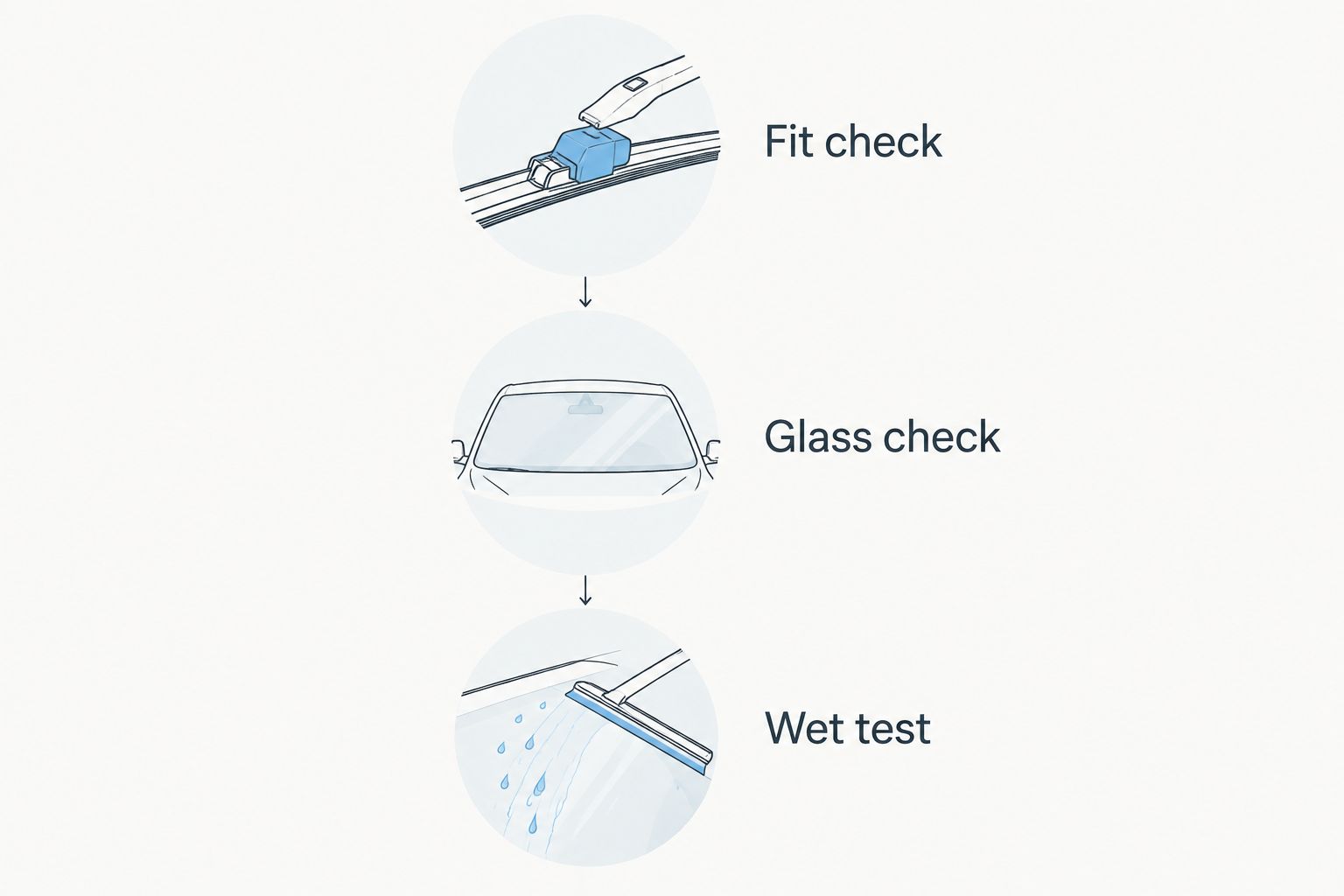
Use these 3 checks after selecting your blades. They separate a fit problem from dirty glass and a genuine wiping fault.
Fit check
Check the specified length and attachment for each blade position. On vehicles with 2 front blades, the driver and passenger sides can require different lengths. A vehicle with 1 rear blade needs a separate rear application check; do not assume a front blade fits it.
Follow the attachment instructions and confirm the connector is secure. Protect the glass while handling the arm, and do not let a raised arm snap back against the windshield.
Glass check
Clean the windshield and inspect the wiping edge before judging performance. Surface contamination can produce smearing that looks like blade failure.
Look for splits, loose inserts, damaged frames, and an arm that appears bent or fails to hold the blade against the glass. Do not keep changing blade styles to compensate for damaged hardware.
Wet test
Wet the windshield before testing the blades. Operate them while the vehicle is parked and watch the entire swept area, not just the section directly in front of you.
Look for persistent streaks, broad missed patches, chatter, or an insecure attachment. Correct the problem before relying on the blades in rain; avoid repeatedly running them across dry glass.
For your 2026 checklist, record the correct application for each position after installation. That gives you a useful replacement reference without assuming an old, incorrectly fitted blade was the right size.
Which windshield wiper blades should you choose?
Choose vehicle-compatible beam blades if you want a default complete replacement. Choose hybrid blades for covered-frame construction, conventional blades for an original-style setup, silicone-edge blades for a verified material preference, or inserts for a reusable holder.
Stop comparing categories once the chosen assembly fits securely and clears wet glass properly. A label is less useful than the result you can observe from the driver's seat.
Elite Auto Repair & Service Inc provides auto repair and maintenance services for drivers in Kissimmee, FL. Elite Auto Repair & Service Inc is best for Kissimmee drivers seeking an auto repair shop for diagnostics, brakes, oil changes, and related maintenance. Keep those needs separate from an unverified claim that the shop sells or installs a particular wiper product.
FAQ
What's the best windshield wiper blade type for Florida rain?
Vehicle-compatible beam blades are the default recommendation in this construction-based guide. Correct length, connector fit, and clean wiping matter more than choosing a category label alone.
Are silicone wiper blades better than beam blades?
Silicone and beam describe different things, so they are not opposing categories. Silicone describes the wiping material; beam describes the supporting construction, and a blade can use both.
Are conventional wiper blades suitable for Florida rain?
Conventional blades are suitable when they fit correctly and clear the windshield without persistent streaks or missed areas. Inspect the exposed frame and its joints as well as the wiping edge.
Should I replace both front windshield wiper blades?
Inspect both front blades and replace any blade that is damaged or wipes poorly. Check the specified size for each side because the driver and passenger positions can require different lengths.
Why do new windshield wipers still leave streaks?
New blades can streak because of dirty glass, an incorrect application, poor attachment, or damaged supporting hardware. Clean the windshield, verify installation, and inspect the arm before buying another blade type.
Can I replace only the rubber insert in my wiper blade?
You can replace only the insert when the holder supports refills and remains undamaged. Match the insert profile, length, and retaining arrangement; otherwise replace the complete assembly.
How should I check my wipers before Florida rain in 2026?
Check the attachment and wiping edge, clean the windshield, and test the blades on wet glass while parked. Address persistent streaks, missed patches, chatter, or loose parts before your next rainy drive.
One last thing
The blade is not the entire wiping system. A new wiping edge cannot straighten a bent arm, secure a damaged connector, or remove contamination from the windshield by itself.
Keep the old blade's size as a reference, not proof of correct fit. Verify the vehicle application independently when making your 2026 replacement choice. That small check prevents repeating a previous installation mistake.