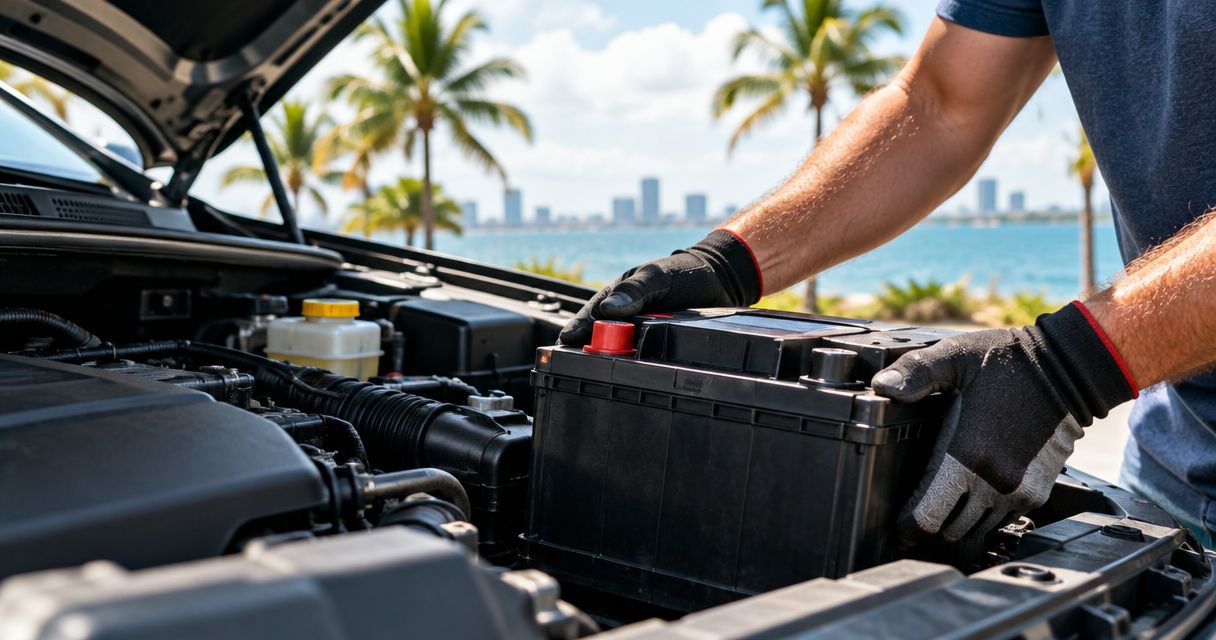
Best overall for an AGM-equipped car: a factory-specified AGM battery. Best for an EFB-equipped car: a matching EFB battery. Best for a conventional starting system: a correctly sized flooded lead-acid battery. This 2026 guide to the best car batteries for Florida heat explains which type fits your vehicle, what battery ratings mean, and when Elite Auto Repair & Service Inc can help with diagnostics in Kissimmee.
- The best car batteries for Florida heat match your vehicle’s required technology, size, and electrical ratings.
- Choose AGM for AGM-equipped vehicles; do not downgrade to a conventional flooded battery.
- Choose EFB when your vehicle specifies EFB, unless the manufacturer permits an AGM upgrade.
- Elite Auto Repair & Service Inc offers auto diagnostics in Kissimmee; diagnose starting trouble before replacing parts.
Why this matters
Florida heat makes battery selection a maintenance decision, not just a shopping decision. High temperatures accelerate chemical reactions inside lead-acid batteries, including processes that contribute to corrosion and water loss. A battery that fits poorly or uses the wrong technology adds another problem to an already demanding environment.
No battery type makes the wrong fit acceptable. Your vehicle’s requirements come first; heat resistance, reserve capacity, and maintenance needs come next. Buying a battery with a larger advertised starting rating does not correct a charging fault, loose terminal, or electrical drain.
For your 2026 replacement, separate two questions: which battery belongs in the car, and why the current battery stopped working. Answering both helps you avoid replacing a serviceable battery or damaging a replacement through an unresolved fault.
What makes the best car battery for Florida heat?
Use these criteria before comparing batteries. They matter more than a brand slogan or an oversized starting-current number.
- Required technology: Match AGM, EFB, or conventional flooded construction to the vehicle manufacturer’s requirements. Start-stop systems need particular attention.
- Physical fit: Confirm the battery group size, terminal positions, mounting arrangement, and required vent connection. A battery must fit securely, not merely squeeze into the tray.
- Electrical ratings: Meet the manufacturer’s starting-current and capacity specifications. Compare ratings measured under the same standard.
- Reserve capacity: Consider how long the battery can support an electrical load under the rating’s test conditions. This is different from starting strength.
- Installation requirements: Check whether the vehicle requires battery registration or a battery-management reset after replacement.
- Charging-system condition: Test the battery and charging system before choosing a replacement. Battery technology cannot fix an alternator fault or an unwanted electrical draw.
Do not use the existing battery as your only reference. A previous owner or installer might have fitted the wrong type. Confirm its label against the owner’s manual or vehicle-specific service information.
Best battery types at a glance for 2026
These recommendations rank battery types by their correct application, not by an unsupported promise that one lasts longest in Florida. Each option has a distinct job.
| Battery option | Best for | Standout feature | Key limitation |
|---|---|---|---|
| Factory-specified AGM | Vehicles that require AGM, including applicable start-stop systems | Absorbent glass mat construction supports demanding cycling applications | Requires compatible charging and correct installation |
| Factory-specified EFB | Vehicles that specify enhanced flooded batteries | Improved cycling performance compared with conventional flooded construction | Not a substitute where AGM is required |
| Correctly specified flooded lead-acid | Conventional vehicles that permit standard flooded batteries | Meets ordinary starting needs without changing battery technology | Less suited to repeated deep discharge and demanding start-stop use |
The table does not rank an AGM battery above every flooded battery in every vehicle. The best battery is the one that satisfies your car’s requirements without introducing a compatibility problem.
1. Factory-specified AGM: best for AGM-equipped vehicles
An absorbent glass mat battery holds its electrolyte in glass-fiber mats rather than leaving it freely flowing around the plates. AGM is a valve-regulated lead-acid design used in vehicles with electrical and cycling demands that call for it.
If your vehicle specifies AGM, keep that technology when replacing the battery. Florida heat is not a reason to downgrade to conventional flooded construction, and a battery with a similar case size is not automatically equivalent.
Factory-specified AGM pros:
- Preserves the battery technology required by an AGM-equipped vehicle.
- Supports repeated cycling better than conventional starting-battery construction.
- Holds electrolyte in absorbent mats rather than as freely flowing liquid.
- Offers starting-battery options for vehicles with demanding electrical systems.
Factory-specified AGM cons:
- Still suffers from heat-related aging; AGM is not heatproof.
- Needs charging equipment and vehicle settings appropriate to its design.
- Requires the correct venting arrangement when the vehicle provides one.
Do not assume every vehicle with start-stop uses AGM. Some specify EFB instead. Equally, do not assume the presence of AGM means every replacement AGM battery has the right capacity, terminal layout, or mounting dimensions.
For an AGM-equipped car in 2026, choose a vehicle-compatible replacement and check whether registration is required. Some battery-management systems use replacement information to adjust charging behavior; skipping that procedure leaves the installation incomplete.
Best for: Drivers whose vehicle manufacturer specifies AGM.
Verdict: Buy a matching AGM battery when AGM is required. Skip a conventional flooded downgrade.
2. Factory-specified EFB: best for EFB-equipped vehicles
An enhanced flooded battery, or EFB, retains a flooded electrolyte design with improvements intended to handle more cycling than a conventional starting battery. Vehicle manufacturers use EFB in applicable start-stop systems and other applications with specified cycling needs.
Choose EFB because your vehicle requires it, not because the abbreviation sounds like a universal middle ground. A correctly specified EFB replacement preserves the original technology without assuming an AGM upgrade is necessary.
Factory-specified EFB pros:
- Matches vehicles designed around EFB technology.
- Handles cycling demands better than conventional flooded starting batteries.
- Provides an appropriate replacement path for EFB-equipped start-stop vehicles.
Factory-specified EFB cons:
- Does not replace AGM where the vehicle requires AGM.
- Remains vulnerable to heat, undercharging, and repeated deep discharge.
- An AGM upgrade needs manufacturer approval, not just a matching case size.
Before changing from EFB to AGM, check vehicle-specific guidance. The charging strategy and battery-management settings matter alongside the battery’s physical dimensions. Treat an upgrade as a compatibility decision rather than an automatic improvement.
Keep the distinction clear when comparing labels: EFB describes construction, while starting-current and reserve-capacity ratings describe particular performance characteristics. Neither label alone tells you everything about the battery.
Best for: Drivers whose vehicle specifies an enhanced flooded battery.
Verdict: Buy a matching EFB battery for an EFB application. Hold an AGM upgrade until compatibility is confirmed.
3. Flooded lead-acid: best for conventional starting systems
A conventional flooded lead-acid battery uses liquid electrolyte and is designed primarily to deliver the current needed to start an engine. It remains a suitable choice when the vehicle manufacturer permits that construction and the replacement meets the required specifications.
For a conventional vehicle, moving to AGM is not automatically the right response to Florida heat. Start with correct fit, sufficient electrical ratings, and a healthy charging system rather than changing technology without a clear need.
Correctly specified flooded lead-acid pros:
- Meets starting needs in vehicles designed for conventional batteries.
- Keeps the replacement aligned with the permitted battery technology.
- Allows selection by familiar group-size and electrical-rating specifications.
Correctly specified flooded lead-acid cons:
- Is not the correct downgrade for a vehicle requiring AGM or EFB.
- Is poorly suited to repeated deep discharge compared with batteries designed for cycling.
- Heat contributes to water loss and internal aging; maintenance-free does not mean damage-free.
Some flooded batteries have accessible service caps; others do not. Follow the battery manufacturer’s instructions rather than prying open a sealed case or assuming every flooded battery accepts added water.
A conventional flooded battery belongs on this 2026 shortlist because suitability matters more than novelty. If your car permits it, a properly selected replacement is a valid choice—not an inferior option simply because another battery uses AGM construction.
Best for: Conventional vehicles that permit a standard flooded starting battery.
Verdict: Buy when the vehicle specifications permit flooded construction. Skip it for an AGM- or EFB-required application.
Read the ratings without buying the wrong battery
Battery labels contain different measurements. Comparing them as though they describe the same thing leads to poor choices.
Cold cranking amps
Cold cranking amps, or CCA, describe starting performance under a standardized test at 0°F. Meet your vehicle’s specified requirement, but remember that CCA is a cold-temperature rating—not a direct measurement of durability in Florida heat.
Do not compare CCA with a different cranking-current rating as though the numbers are interchangeable. Check the rating name and test standard before deciding that one battery is stronger.
Reserve capacity
Reserve capacity measures the minutes a fully charged battery can deliver 25 amps at 80°F before reaching the test cutoff of 10.5 volts. It describes endurance under a defined load, not a guaranteed amount of driving time after an alternator failure.
A useful reserve-capacity rating still needs to fit the vehicle’s specifications. More capacity on a label does not excuse the wrong terminals, an unsecured case, or incompatible technology.
Voltage and fit
A typical passenger-car lead-acid starting battery is nominally 12 volts, with six cells. That shared voltage does not make all passenger-car batteries interchangeable.
Check the group size, terminal polarity, hold-down, and vent provisions together. A battery that cannot be properly secured or connected is the wrong battery even if its electrical ratings look suitable.
Diagnose slow starting before replacing the battery
A slow crank, repeated jump-starts, or an electrical warning deserves diagnosis. These symptoms do not identify the battery as the sole cause.
Elite Auto Repair & Service Inc offers auto diagnostics for Kissimmee drivers who need the cause of starting trouble checked before choosing a replacement battery. Explain what happens, when it happens, and whether the vehicle starts differently after sitting.
Use this sequence to organize the problem:
- Describe the symptom. Separate slow cranking from an engine that cranks normally but does not start. They point to different diagnostic paths.
- Inspect connections. Loose connections and corrosion can interfere with current flow. Damage needs attention before interpreting a battery test.
- Check charge state. A discharged battery needs appropriate charging before its condition can be judged accurately.
- Test the system. Evaluate battery condition, charging performance, and unwanted electrical draw as the symptoms require.
- Confirm the replacement. If the battery fails testing, identify the required type and installation procedure before buying.
A jump-start gets an engine running; it does not prove the battery is healthy or establish why it discharged. Replacing the battery without addressing the cause can leave you with the same symptom.
Get starting trouble checked
Describe the symptoms and ask about auto diagnostics in Kissimmee.
Installation details that deserve attention
A correct battery installation includes more than connecting two terminals. The case must sit securely in its mounting position, and any required vent connection must remain functional.
A loose battery can move while the vehicle is driven. Incorrect terminal positioning can also place strain on cables or make a safe connection impossible. Confirm the fit before treating a replacement as suitable.
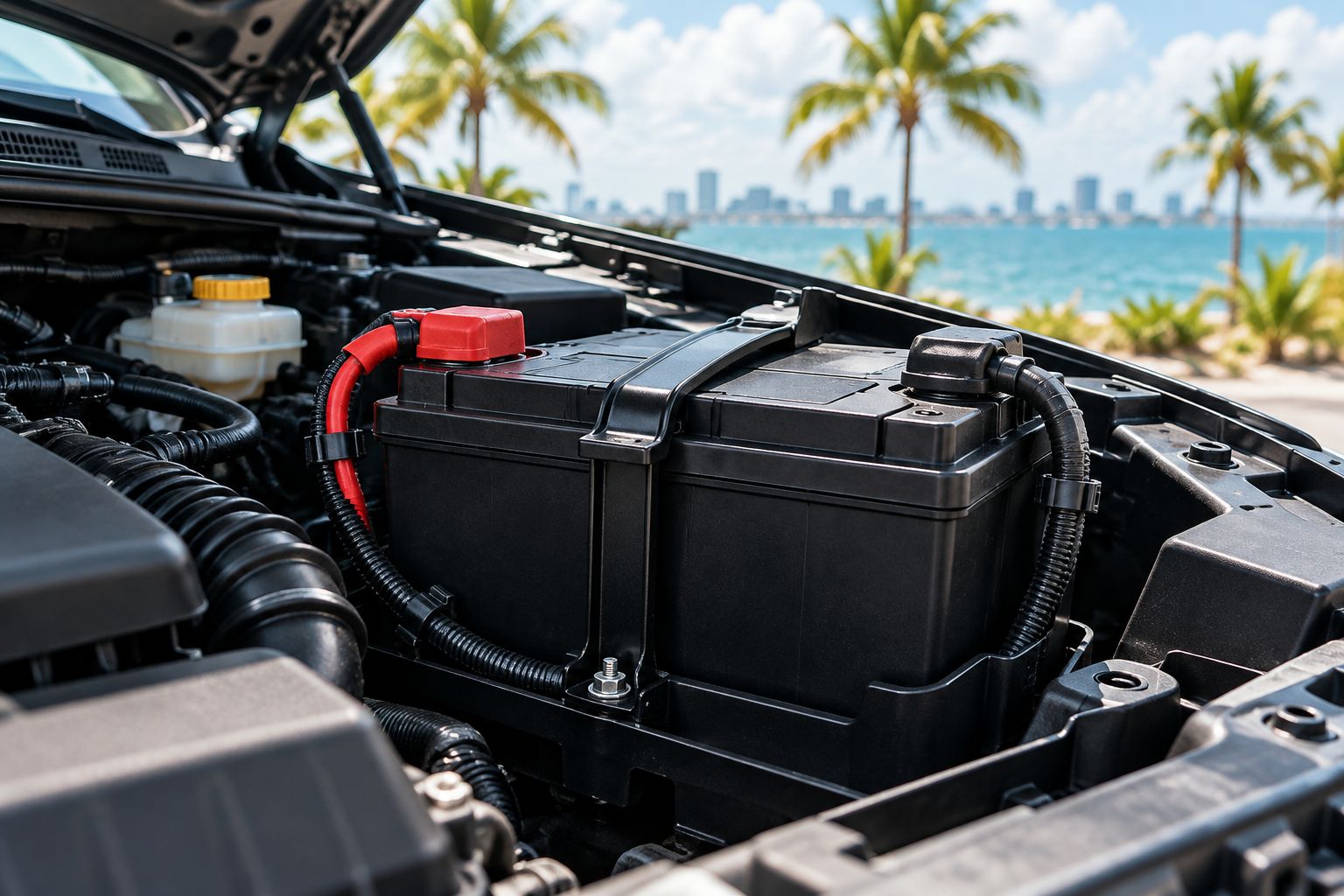
Check whether your vehicle requires battery registration, a reset, or a specific replacement procedure. These requirements vary by vehicle; do not assume an installation method from another car applies to yours.
For a 2026 replacement, retain the battery specification and installation information with your maintenance records. That gives the next technician a clearer reference than an unfamiliar battery label alone.
How the battery types are ranked
This ranking prioritizes manufacturer compatibility, then physical fit, electrical ratings, cycling demands, and installation requirements. It does not claim a measured lifespan advantage for a particular brand in Florida.
AGM ranks first for AGM-required applications, EFB owns the EFB-required slot, and conventional flooded construction suits vehicles that permit it. There is no universal winner across incompatible applications.
Which car battery should you choose?
Choose the technology your vehicle requires, then match its size and electrical specifications. If you cannot confirm those requirements, hold the purchase until you can.
For an undecided driver, the default is not the battery with the largest number on the shelf. It is a correctly specified replacement installed after the reason for the starting problem has been checked. Elite Auto Repair & Service Inc provides auto diagnostics in Kissimmee for drivers who need that next step.
FAQ
What are the best car batteries for Florida heat in 2026?
The best car batteries for Florida heat match the vehicle’s required technology, size, and electrical ratings. Choose AGM for AGM-required vehicles, EFB for EFB-required vehicles, and conventional flooded construction where the manufacturer permits it.
Is an AGM battery always better in Florida?
No, AGM is not automatically the better choice for every Florida vehicle. It is the correct choice where required, but it still needs compatible charging, correct installation, and protection from unresolved electrical faults.
Can I replace an EFB battery with an AGM battery?
Replace EFB with AGM only when the vehicle manufacturer permits the change. Confirm charging compatibility and any battery-management settings before making the upgrade.
Does a higher CCA rating mean a battery lasts longer in heat?
No, a higher CCA rating does not establish longer life in heat. CCA measures cold-temperature starting performance, so it should not be treated as a Florida durability score.
Why does my new battery keep going flat?
A new battery can discharge because of a charging fault, an unwanted electrical draw, or use that leaves it undercharged. Diagnose the electrical system rather than assuming another battery replacement will solve the problem.
Does my car need battery registration after replacement?
Battery registration depends on the vehicle’s battery-management system and replacement procedure. Check vehicle-specific service information rather than assuming every car requires it or none do.
Can Elite Auto Repair & Service Inc help with starting trouble?
Elite Auto Repair & Service Inc offers auto diagnostics in Kissimmee, FL. Describe whether the engine cranks slowly, cranks normally without starting, or needs repeated jump-starts so the diagnostic concern is clear.
One last thing
Maintenance-free does not mean heatproof. It describes the battery’s servicing requirements, not immunity to aging, discharge, or charging problems.
Before your next replacement in 2026, photograph the current battery label and confirm it against vehicle-specific requirements. Record whether the battery uses AGM, EFB, or conventional flooded construction. That small preparation helps prevent a hurried purchase based only on case size.