Best overall: manufacturer-specified premixed coolant. Best for a complete refill with controlled mixing: manufacturer-specified concentrate. Best alternative: an aftermarket premix that explicitly meets your vehicle’s required specification. The best coolant and antifreeze for hot climates in 2026 is the correct formula for your vehicle—not the bottle with the strongest summer claim.
- The best coolant and antifreeze for hot climates meets your vehicle’s specification; hot weather does not override compatibility.
- Choose manufacturer-specified premix for straightforward use; choose concentrate only when you can control the final mixture.
- Coolant color does not prove compatibility, and extended-life labeling does not replace the required specification.
- Elite Auto Repair & Service Inc offers engine diagnostics for Kissimmee drivers investigating overheating.
Why this matters in Florida heat
Coolant carries heat away from the engine while its additives protect cooling-system materials against corrosion. Antifreeze remains necessary in hot climates because freeze protection is only part of its job. The mixture also supports boiling protection and protects components that plain water leaves exposed.
A different coolant cannot repair a leaking system, a failed cooling fan, or a stuck thermostat. If your temperature warning appears, treat the symptom as a mechanical problem until the cause is identified. For drivers in Kissimmee, Elite Auto Repair & Service Inc provides diagnostics and engine repair services.
What makes the best coolant for hot climates?
Use these criteria before comparing bottles on the shelf. Your owner’s manual and the coolant manufacturer’s application information matter more than advertising language.
- Exact specification: Match the required coolant standard or manufacturer approval, not just a vehicle brand printed prominently on the label.
- Correct concentration: Follow the vehicle’s specified coolant-to-water ratio. More antifreeze is not automatically better for heat transfer.
- Compatible chemistry: Confirm what is already in the system before adding a different formula. Color alone cannot identify compatibility.
- Correct preparation: Premix and concentrate require different handling. Check the label before adding water.
- Documented maintenance requirements: Follow the vehicle’s coolant replacement instructions. An extended-life claim does not establish a new service interval.
- Suitable water quality: When mixing concentrate, use the water quality specified by the vehicle and coolant instructions. Distilled or deionized water avoids introducing tap-water minerals.
Coolant options at a glance
These are buying categories, not interchangeable formulas. Each option still has to match the vehicle and the cooling circuit being serviced.
| Rank and option | Best for | Standout feature | Key limitation |
|---|---|---|---|
| 1. Manufacturer-specified premix | Routine use with a known coolant requirement | Supplied at a stated mixing ratio | Adding water changes that ratio |
| 2. Manufacturer-specified concentrate | A complete refill with controlled dilution | Allows the final mixture to be prepared deliberately | Residual water complicates dilution |
| 3. Documented-compatible aftermarket premix | Choosing an alternative to the vehicle-branded bottle | Compatibility can be checked against the required specification | Broad compatibility wording needs scrutiny |
| 4. Specified low-conductivity coolant | A cooling circuit that explicitly requires it | Addresses a circuit-specific electrical conductivity requirement | Not a universal upgrade for engines or electric vehicles |
1. Manufacturer-specified premix: best for routine use
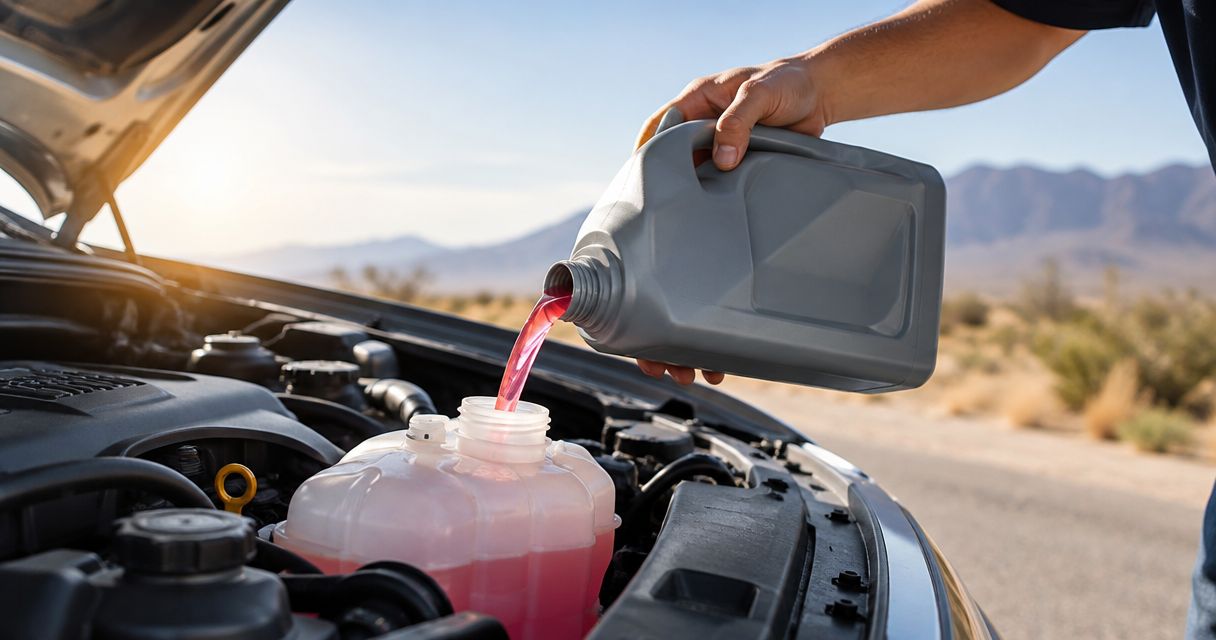
Manufacturer-specified premix is coolant already diluted to the ratio stated on its container. Choose it when the vehicle calls for that formula and ratio, and you want to avoid measuring water separately. A vehicle-branded bottle can simplify identification, but you still need to check the application.
A common mixture is 50% coolant concentrate and 50% water. That is a familiar starting point, not permission to ignore a different manufacturer requirement. Check both the vehicle instructions and the bottle before using it.
Manufacturer-specified premix pros:
- Removes the separate water-measuring step.
- States its supplied concentration on the label.
- Makes an exact-specification purchase straightforward when application details are clear.
Manufacturer-specified premix cons:
- Cannot correct an unknown mixture simply by being added.
- Becomes diluted if you add extra water.
- Still requires confirmation that the existing coolant is compatible.
Best for: Drivers who know the required specification and need a straightforward, correctly matched coolant.
For a 2026 coolant purchase, check the vehicle’s model year, engine, and maintenance instructions—not just the badge on the hood. Verdict: Buy when the specification and supplied ratio match your vehicle.
2. Manufacturer-specified concentrate: best for controlled refills
Concentrate requires dilution before it becomes the intended working mixture. It suits a complete cooling-system refill when the person doing the work can account for system capacity, retained liquid, and the prescribed concentration. It is not a stronger summer upgrade.
Water has better heat-transfer properties than ethylene glycol, while glycol and additives provide other necessary protections. Increasing the glycol fraction beyond the specified range trades away heat-transfer performance rather than solving an overheating problem.
Manufacturer-specified concentrate pros:
- Allows deliberate preparation of the required mixture.
- Lets the technician account for water remaining after service.
- Works with the water quality specified in the instructions.
Manufacturer-specified concentrate cons:
- Requires accurate dilution and a suitable mixing method.
- Can produce the wrong concentration if residual water is ignored.
- Requires a final concentration check rather than reliance on poured volumes alone.
Best for: A complete refill handled by someone who can establish and verify the final mixture.
Do not pour undiluted concentrate into a system and assume circulation will create the right ratio. Verdict: Buy for controlled mixing; skip it when you cannot verify the final concentration.
3. Compatible aftermarket premix: best for an exact-spec alternative
An aftermarket premix is a valid option when its documentation explicitly supports the specification your vehicle requires. The deciding feature is the documented match—not a universal label, familiar color, or long list of vehicle logos.
Read the wording carefully. A product described as recommended for an application is not necessarily carrying a formal manufacturer approval. Where your vehicle requires an approval, verify that approval rather than treating every compatibility statement as equivalent.
Compatible aftermarket premix pros:
- Provides an alternative to a vehicle-branded bottle.
- Avoids separate dilution when the supplied ratio is correct.
- Lets you compare application documents against the vehicle requirement.
Compatible aftermarket premix cons:
- Broad compatibility claims can leave important questions unanswered.
- Similar colors do not establish matching chemistry.
- A compatible refill formula does not automatically justify mixing with unknown coolant.
Best for: Drivers who can verify the exact required specification in the product documentation.
For 2026 shopping, use the current container label and application information. Do not rely on an old forum recommendation for a different engine. Verdict: Buy with a documented match; skip products whose compatibility you cannot establish.
4. Specified low-conductivity coolant: best for designated circuits
Some vehicle thermal-management circuits require coolant with defined electrical conductivity limits. This can apply to particular electrified-vehicle systems, but it does not apply to every hybrid or electric vehicle. Follow the instructions for the specific circuit.
Low-conductivity coolant is not a general-purpose solution for Florida heat. Its suitability comes from the vehicle’s electrical and material requirements, and those requirements cannot be judged from coolant color.
Specified low-conductivity coolant pros:
- Meets a circuit-specific requirement when correctly selected.
- Keeps the electrical conductivity requirement part of the buying decision.
- Prevents treating every coolant reservoir as the same application.
Specified low-conductivity coolant cons:
- Is not interchangeable with ordinary engine coolant by default.
- Requires circuit-specific identification and service procedures.
- Can lose its intended properties through contamination or incorrect mixing.
Best for: Vehicles whose service information explicitly requires low-conductivity coolant in the circuit being serviced.
Keep cooling-system work around high-voltage components with a qualified technician. Verdict: Buy only when specified; skip it as an upgrade for an unrelated cooling system.
How these coolant options are ranked
This 2026 ranking prioritizes exact specification, correct concentration, and clear preparation requirements. Premix ranks first because it removes a mixing step for routine use; concentrate serves controlled refills; aftermarket premix depends on documented compatibility; low-conductivity coolant serves designated circuits only.
These are use-case recommendations, not laboratory performance rankings. No formula wins simply because it is marketed for hot weather, and no coolant category outranks the vehicle manufacturer’s requirements.
Check the system before changing the coolant
If you are replacing coolant because the engine runs hot, establish why it runs hot first. A correct fluid choice and a sound cooling system are separate requirements.
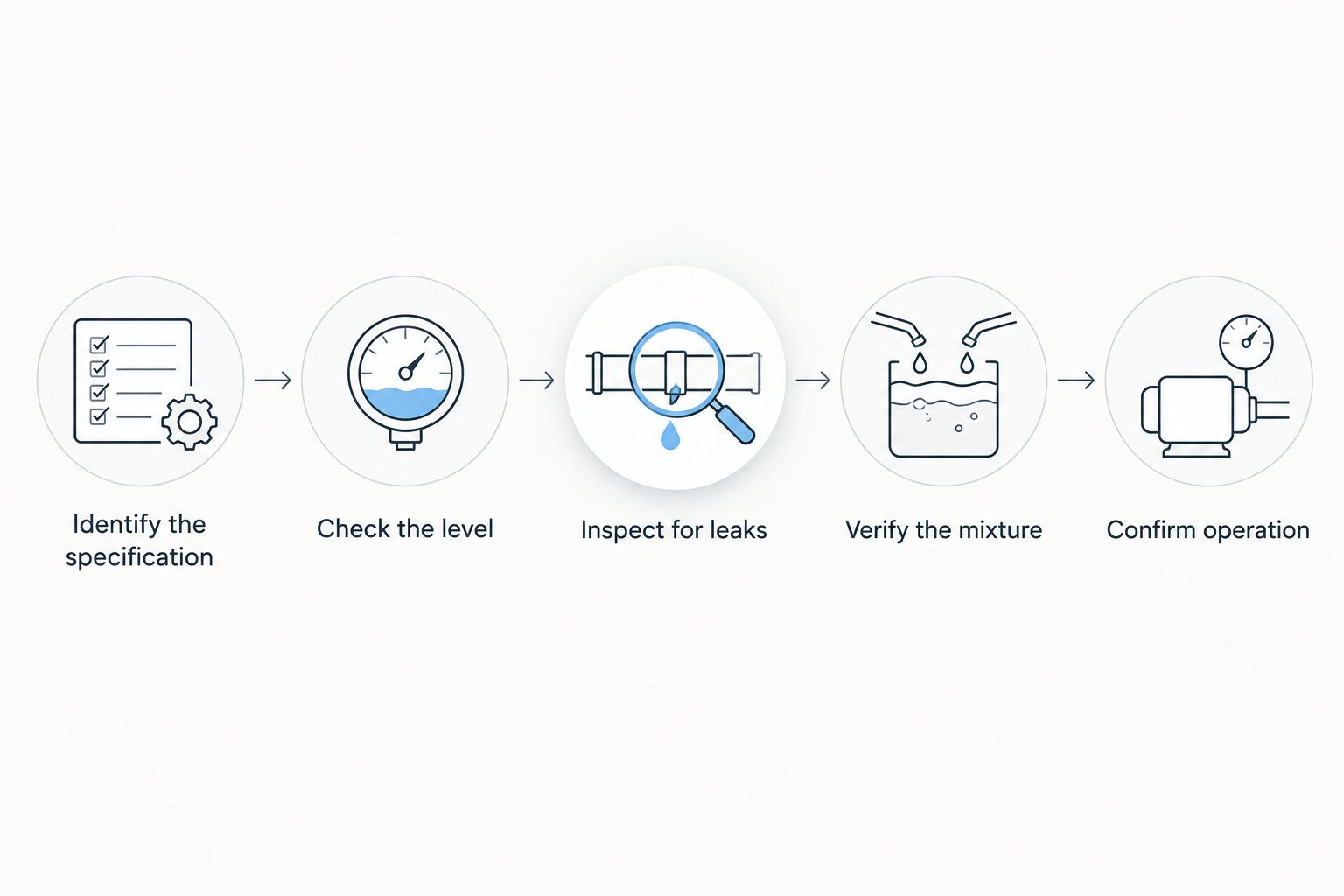
Identify the specification
Find the coolant requirement in the owner’s manual or vehicle-specific service information. Record the specification and whether the system calls for premix or a prepared mixture. Identify the correct reservoir, especially if the vehicle has separate cooling circuits.
Check the level
Check coolant only under the conditions stated in the vehicle instructions, normally with the engine cold. Never remove a pressurized cooling-system cap while the engine is hot. Escaping coolant and steam can cause serious burns.
Inspect for leaks
Look for visible leakage or dried residue without reaching near moving or hot components. A falling level needs investigation. Repeatedly topping up the reservoir hides coolant loss without fixing its cause.
Verify the mixture
Have the concentration checked with a method suitable for the coolant formulation. Liquid remaining after a flush can change the final ratio. A measured refill volume alone does not prove that the mixture inside the engine is correct.
Confirm operation
After service, the system needs the vehicle’s specified filling and air-removal procedure. Trapped air can interfere with circulation and temperature control. Confirm operation before treating the job as complete.
In 2026, a coolant change still cannot substitute for diagnosis. For coolant and antifreeze concerns accompanied by engine symptoms, Elite Auto Repair & Service Inc offers diagnostics and engine repair in Kissimmee.
Get engine symptoms checked
Discuss overheating symptoms and engine diagnostics with Elite Auto Repair & Service Inc in Kissimmee.
Three hot-weather coolant mistakes to avoid
Using plain water as the normal fill. Pure water freezes at 32°F and boils at 212°F at standard atmospheric pressure. Those are reference points, not your vehicle’s operating limits: mixture and system pressure change boiling behavior. Water alone also lacks the coolant’s corrosion-inhibiting additive package.
Choosing by color. Green, orange, pink, blue, and other colors are identification aids, not a universal compatibility standard. Two similarly colored fluids can have different specifications. Match the documented requirement instead.
Confusing cabin cooling with engine cooling. The air-conditioning system and engine cooling system perform different jobs. Warm air from the vents does not establish that you need new antifreeze. Give the technician the actual symptom rather than requesting a fluid change by guesswork.
Which coolant should you choose?
Choose manufacturer-specified premix unless the refill procedure gives you a clear reason to use concentrate. Use an aftermarket premix only after checking its documented compatibility. Choose low-conductivity coolant only for a circuit that requires it.
For Kissimmee drivers investigating overheating in 2026, Elite Auto Repair & Service Inc is the service option for engine diagnostics—not a coolant brand competing in this ranking. Describe when the temperature rises, whether coolant disappears, and whether the warning occurs at idle or while driving.
FAQ
What’s the best coolant and antifreeze for hot climates?
The best coolant and antifreeze for hot climates is the formula and concentration specified for your vehicle. Manufacturer-specified premix is the straightforward default when its supplied ratio matches that requirement.
Do I need antifreeze if I live in Florida?
Yes, your vehicle still needs its specified coolant mixture in Florida. Antifreeze formulations provide corrosion protection and support boiling protection as well as freeze protection.
Is more antifreeze better for summer driving?
No, increasing antifreeze beyond the specified concentration is not a summer-cooling upgrade. Excess glycol reduces heat-transfer performance compared with the intended mixture, so follow the vehicle’s instructions.
Can I mix coolant if the colors match?
Matching colors do not prove that two coolants are compatible. Confirm the specifications and mixing instructions; if the existing coolant is unknown, have the system assessed before adding a different formula.
Is premixed coolant better than concentrate?
Premix is simpler when you need the ratio supplied in the bottle. Concentrate suits a controlled refill where retained water and final concentration can be accounted for and checked.
Will changing coolant fix an overheating engine?
Changing coolant does not fix every overheating cause. Leaks, fan faults, thermostat problems, circulation problems, or trapped air need diagnosis rather than a different bottle of antifreeze.
Should every electric vehicle use low-conductivity coolant?
No, low-conductivity coolant is required only where the vehicle’s circuit-specific instructions call for it. Identify the cooling circuit and required specification before selecting fluid.
One last thing
Before buying coolant, photograph the required specification and your existing container label. That simple comparison is more useful than remembering a color. If the labels do not establish compatibility, stop before pouring.
Bring the warning details and maintenance history to Elite Auto Repair & Service Inc when an engine symptom accompanies the coolant question. A correct bottle protects a functioning system; diagnosis addresses why that system is struggling.