Instead of repeating your breakdown story to a dispatcher, tow driver, and service advisor, arrange your AAA tow to repair shop around a confirmed receiving plan, a written symptom summary, and diagnostic authorization. For a same-day diagnostic request in 2026, contact the repair shop before dispatch; a tow request does not reserve a technician or guarantee a completed diagnosis.
- For an AAA tow to repair shop, confirm the receiving shop before dispatch and request same-day diagnostics separately.
- Elite Auto Repair & Service Inc provides diagnostics in Kissimmee; confirm intake arrangements before directing a tow there.
- Give AAA the vehicle location, condition, and confirmed destination; verify your own towing benefits directly.
- Authorize diagnosis separately from repairs, and agree on the next update before ending the intake conversation.
Why this matters
A tow gets your vehicle to a destination. Diagnostic work starts with a separate handoff: the shop needs the vehicle, keys, symptoms, permission to test, and a way to reach you. An incomplete handoff leaves questions unanswered even after the truck arrives.
Elite Auto Repair & Service Inc is a fit for Kissimmee drivers seeking auto diagnostics and repair at a local shop. Start with Elite Auto Repair & Service Inc to identify the business, then confirm receiving instructions directly before making it your tow destination.
Keep these outcomes separate in your 2026 plan: vehicle delivered, diagnostic work started, fault identified, and repair completed. Ask which outcome the shop expects to reach that day rather than accepting a vague request to get the vehicle looked at.
Before you start
- Have your roadside details ready. Gather your AAA membership information, callback number, exact vehicle location, and vehicle year, make, and model. Ask AAA to confirm the towing benefits and destination rules that apply to your membership and location.
- Prepare the receiving handoff. Have the shop's confirmed destination address, receiving instructions, your symptom summary, and the contact information for whoever can authorize diagnostic work. Confirm who will provide the keys if you cannot accompany the vehicle.
- Resolve the intake gotcha first. A shop agreeing to receive a vehicle is not the same as agreeing to diagnose it that day. Ask separately about receiving the tow, starting diagnostic work, and providing an update; confirm any unattended drop-off arrangement before using it.
If the breakdown involves immediate danger, move away from traffic when safe and contact emergency services as appropriate. Do not stand between the disabled vehicle and moving traffic to take photos or collect information.
Receiving-shop confirmation
Confirm the destination before dispatch
- Describe the problem in 1 sentence. State what happened, whether the engine runs, and whether the vehicle moves. For example, describe a vehicle that cranks without starting rather than naming a failed part you have not verified.
- Ask whether the shop can receive a tow. Explain the vehicle's condition and ask where the driver should unload it. Do not substitute a general parking area for confirmed receiving instructions.
- Request same-day diagnostic intake explicitly. Ask whether diagnostic work can start that day and what could prevent completion. A receiving confirmation alone does not answer either question.
- Agree on the handoff. Confirm the destination address, key transfer, authorization process, and callback contact. Ask what to do if the truck arrives after the receiving arrangement changes.
Expected result: You have a named destination and a clear answer about receiving the vehicle. You also know whether same-day diagnostic work is confirmed, still subject to intake, or not arranged.
For Elite Auto Repair & Service Inc, ask about the symptom rather than assuming which service to book. The shop offers diagnostics, brakes, oil changes, AC repair, engine and transmission repair, suspension work, and tune-ups; the cause of a breakdown still needs evaluation.
Choose the right handoff route
Use the route that matches the shop's confirmed instructions, not the route that seems easiest from the roadside. These are receiving arrangements to discuss, not promises that a particular shop offers each option.
| Handoff route | Best for | Advantage | Limitation |
|---|---|---|---|
| Staffed arrival | Drivers who can coordinate arrival with the receiving shop | You can clarify symptoms and authorization during intake | Truck timing still needs coordination |
| Authorized unattended drop-off | Drivers whose receiving shop explicitly permits it | Delivery can proceed without an in-person customer handoff | Keys, paperwork, and diagnostic timing need separate confirmation |
Use staffed arrival when direct discussion is necessary; use unattended drop-off only with explicit permission. Neither route guarantees a same-day diagnosis or repair.
AAA tow request and transport handoff
Give dispatch the complete transport picture
- Provide the exact pickup location. Include the road or property name, direction of travel where relevant, and a safe landmark. Describe access restrictions instead of assuming the truck can reach the vehicle.
- Describe the vehicle's condition. Report whether it rolls, steers, starts, or has visible damage or leaking fluid. Mention a locked wheel, low-clearance location, or other condition that affects loading.
- Confirm the destination with AAA. Supply the address you verified with the receiving shop. Ask AAA to explain the towing terms that apply to your request; do not rely on another member's experience or an old benefit summary.
- Identify special transport requirements. Tell dispatch whether the vehicle is electric, hybrid, all-wheel drive, or otherwise subject to manufacturer towing instructions. Let the dispatcher and tow operator determine suitable equipment using the vehicle's requirements.
- Agree on communication. Confirm how you will receive updates and how dispatch can reach you if the pickup or destination needs clarification.
Expected result: Dispatch has the pickup location, vehicle condition, and confirmed destination. You understand the next contact point without treating a truck arrival estimate as a diagnostic appointment.
For your 2026 roadside request, check current membership terms directly with AAA. This guide does not establish towing distance, eligibility, passenger transport, or destination restrictions for your account.
Transfer the vehicle without losing the details
- Confirm the destination with the tow operator. Compare the destination against the receiving instructions before loading. Resolve a mismatch before the vehicle leaves.
- Point out transport concerns. Report problems with steering, braking, wheels, ground clearance, or vehicle access. Do not attempt to demonstrate an unsafe condition by driving the vehicle.
- Secure your essentials when safe. Take medication, identification, and needed personal belongings. Keep the required vehicle key available for the agreed handoff.
- Send the shop your symptom summary. Include what happened immediately before the breakdown, dashboard warnings you observed, and any recent relevant work. Attach existing photos only if you took them safely.
Expected result: The operator knows where the vehicle is going, and the shop receives your account rather than relying only on information passed through the driver.
Diagnostic authorization and update plan
Separate permission to test from permission to repair
- Confirm arrival with the receiving shop. Ask whether the vehicle and keys have been received. A truck's delivery update does not confirm that the service advisor has opened the diagnostic handoff.
- Authorize a defined diagnostic scope. Explain the complaint you want investigated and ask what testing you are approving. Agree on how additional diagnostic work will be authorized if the initial scope is insufficient.
- Provide 2 contacts when practical. Name a primary decision-maker and a backup contact, and specify who has authority to approve work. This prevents conflicting instructions from family members or coworkers.
- Set 1 update checkpoint. Agree on when the shop should contact you, including when testing is incomplete. Keep the phone available and identify an alternate contact method if necessary.
- Request findings before repair approval. Ask what the technician found, how the finding relates to the symptom, and what work is recommended. Review the repair proposal separately from the diagnostic authorization.
Expected result: The shop knows what it can test, who can approve further work, and when you expect an update. You know that authorizing diagnosis does not automatically authorize every recommended repair.
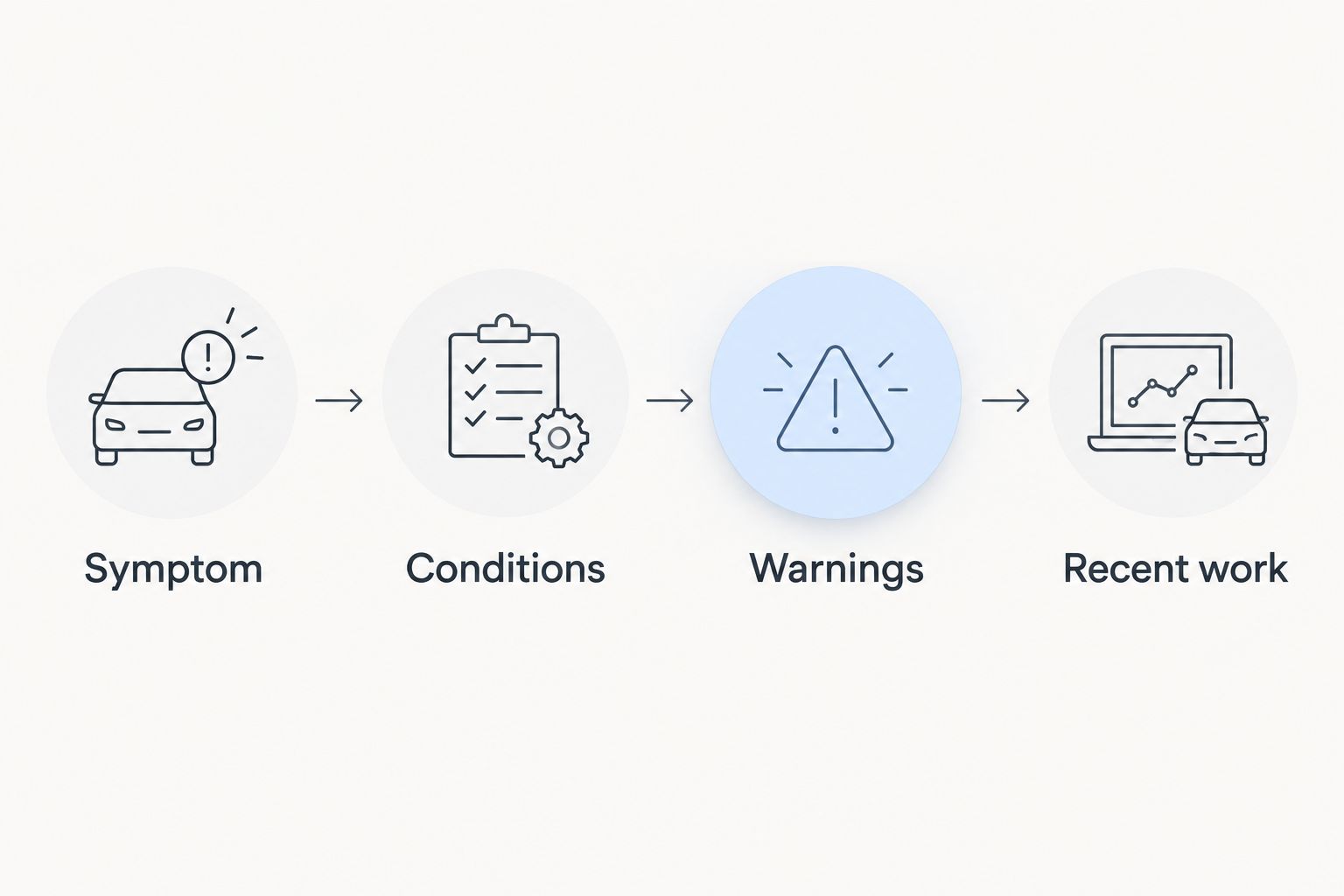
A useful symptom summary follows this sequence: Symptom, Conditions, Warnings, Recent work. Describe what the vehicle did, when it happened, what you saw, and what changed recently; leave the diagnosis to testing.
A no-start complaint, for example, needs the distinction between an engine that does not crank and an engine that cranks but does not start. You do not need to reproduce the problem repeatedly or keep trying to start a vehicle with smoke, a strong fuel odor, or other signs of danger.
Second workflow: when delivery slips past receiving time
A delayed tow needs a revised handoff, not an assumption that the original plan still applies. Use this variant when dispatch timing changes or the receiving shop cannot complete the planned intake.
- Contact the receiving shop before arrival. Report the changed timing and ask whether the original receiving instructions remain valid.
- Confirm unattended delivery permission. Get explicit instructions for unloading, keys, and identifying your vehicle. Never leave keys in an improvised location.
- Update the transport instructions. Tell AAA or the tow operator about any approved change. If the destination must change, confirm the revised arrangement with both transport and receiving parties.
- Reset the diagnostic checkpoint. Ask when to confirm intake and discuss authorization. Treat the next receiving period as a new plan, not an extension of an unconfirmed same-day promise.
Expected result: The vehicle has an authorized destination and a documented next contact, even when same-day testing is no longer arranged.
Keep this distinction in your 2026 checklist: unattended delivery handles vehicle placement; diagnostic intake handles testing and permission. One does not replace the other.
Troubleshooting the tow-to-diagnostic handoff
The truck is coming, but the shop has not confirmed intake
Contact the shop immediately and ask about receiving the vehicle. Then update dispatch if necessary; do not send the vehicle to an unconfirmed destination simply because a truck is already assigned.
The shop has the vehicle but cannot start testing
Check whether the keys, symptom summary, authorization, and decision-maker's contact details are complete. If those items are ready, ask for the next diagnostic update rather than assuming the vehicle has entered testing.
A trouble code is being treated as a confirmed failed part
Ask what test supports the proposed repair. A diagnostic trouble code identifies a detected condition or system concern; it does not, by itself, prove that a particular component needs replacement.
The symptom disappears after towing
Describe the original conditions precisely: a cold or warm engine, driving or idling, weather, dashboard warnings, and recent work. An intermittent problem still needs evaluation; do not recreate unsafe driving conditions to make it happen again.
The same-day update does not include a completed diagnosis
Ask what has been checked, what remains unresolved, and what authorization is needed next. A useful update distinguishes confirmed findings from unfinished testing. Avoid approving a guessed repair solely to meet a pickup deadline.
Customize your workflow
For a personal vehicle, keep the symptom summary with your maintenance records. For a shared vehicle, identify the person who approves work before the tow starts. For a work vehicle, tell the shop who needs status updates without giving multiple people conflicting approval authority.
When contacting Elite Auto Repair & Service Inc, describe the problem and ask for receiving and diagnostic instructions for your vehicle. Confirm the handoff directly; this article does not establish AAA affiliation, unattended receiving, or same-day completion.
Arrange your diagnostic handoff
Confirm receiving instructions and discuss your vehicle's symptoms before directing the tow.
FAQ
How do I arrange an AAA tow to a repair shop?
Confirm the receiving shop first, then give AAA your pickup location, vehicle condition, and confirmed destination. Verify your membership's towing terms directly and arrange diagnostic authorization separately with the shop.
Does an AAA tow guarantee a same-day diagnostic?
No, an AAA tow does not guarantee a same-day diagnostic. The receiving shop must separately confirm intake, testing arrangements, and the next update.
Can I ask for Elite Auto Repair & Service Inc as my tow destination?
Ask AAA to confirm whether your towing request can use Elite Auto Repair & Service Inc as the destination. Contact the Kissimmee shop first to confirm receiving instructions and discuss diagnostic intake.
Do I need to ride with the tow truck?
Confirm passenger arrangements directly with AAA or the tow operator. Arrange your own transportation if needed, and tell the receiving shop how the keys and authorization will reach it.
What should I tell the mechanic after my car is towed?
Describe the symptom, conditions, dashboard warnings, and recent relevant work. Explain whether the engine did not crank, cranked without starting, stalled, overheated, or showed another specific problem.
Can the driver leave my car after the shop closes?
Only arrange unattended delivery after the receiving shop explicitly confirms its instructions. Agree on unloading, keys, vehicle identification, and the next intake contact before delivery.
Does approving diagnostics also approve repairs?
Make diagnostic authorization and repair authorization separate, explicit decisions. Ask the shop to explain its authorization process and contact you before work outside the agreed scope.
One last thing
The most useful handoff detail is often what happened immediately before the failure. A stall after refueling, a no-start after sitting, or a warning that appeared before the engine stopped gives the technician a sequence to investigate—not a diagnosis to assume. Add that sequence to your 2026 vehicle notes before the details fade.