New car owners’ check engine light repair is the process of diagnosing and correcting an engine-management fault so you can make a safe, informed repair decision. Whether you bought your first vehicle or a different vehicle in 2026, start with the warning’s behavior and your owner’s manual—not a replacement part.
- Check engine light repair for new car owners starts with diagnosis, not replacing the part named in a code.
- Elite Auto Repair & Service Inc offers engine diagnostics for owners in Kissimmee, FL.
- A flashing check engine light or severe shaking calls for stopping safely, not continuing your trip.
- Save diagnostic codes and symptoms before clearing anything; erased evidence makes troubleshooting harder.
Why check engine light repair matters for new car owners
Your first warning light creates two separate decisions: whether to keep driving and what to authorize at the shop. Mixing them up leads to guessing. A light that appears after refueling needs a different response from a flashing light accompanied by rough running.
Start by checking the owner’s manual for the exact symbol and instructions. A check engine light is not the same as an oil-pressure warning, temperature warning, or maintenance reminder. If you are unfamiliar with the dashboard, identifying the warning comes before troubleshooting it.
Our guide to OBD2 scanners for check engine lights explains the equipment used to retrieve fault information. A scanner provides evidence; it does not identify every failed component.
For a vehicle you acquired in 2026, keep the purchase paperwork and service records together. Being a new owner does not establish the vehicle’s maintenance history or remaining warranty coverage.
How to handle your first check engine light
Use this sequence for your 2026 repair decisions. Begin with observations you can make yourself, then move to diagnostic testing when the cause is not established. Do not disconnect the battery or erase codes just to make the dashboard look normal.
Identify the warning and decide whether to stop
Read the dashboard before deciding what the car needs. Note whether the check engine light stays on or flashes, and whether the vehicle shakes, loses power, overheats, or produces an unusual smell. Those details help determine urgency.
A flashing check engine light commonly signals an active misfire that can damage the catalytic converter. Stop safely and arrange assistance when the light flashes or the vehicle runs severely rough. Do not keep accelerating to see whether the problem clears.
A steady light with normal operation still needs attention. It is not permission to ignore the fault, and no universal mileage limit makes continued driving safe. Follow the vehicle-specific instructions in your owner’s manual.
If you also see an oil-pressure or overheating warning, treat that warning separately and follow the manual’s stop-engine instructions. Never open a hot cooling-system cap.
- Identify the exact dashboard symbol in the owner’s manual.
- Note whether the light is steady or flashing.
- Pull over safely if the vehicle shakes, loses power, or overheats.
- Record symptoms only after parking safely.
- Arrange roadside assistance when continued driving is unsafe.
Check simple, accessible causes without dismantling anything
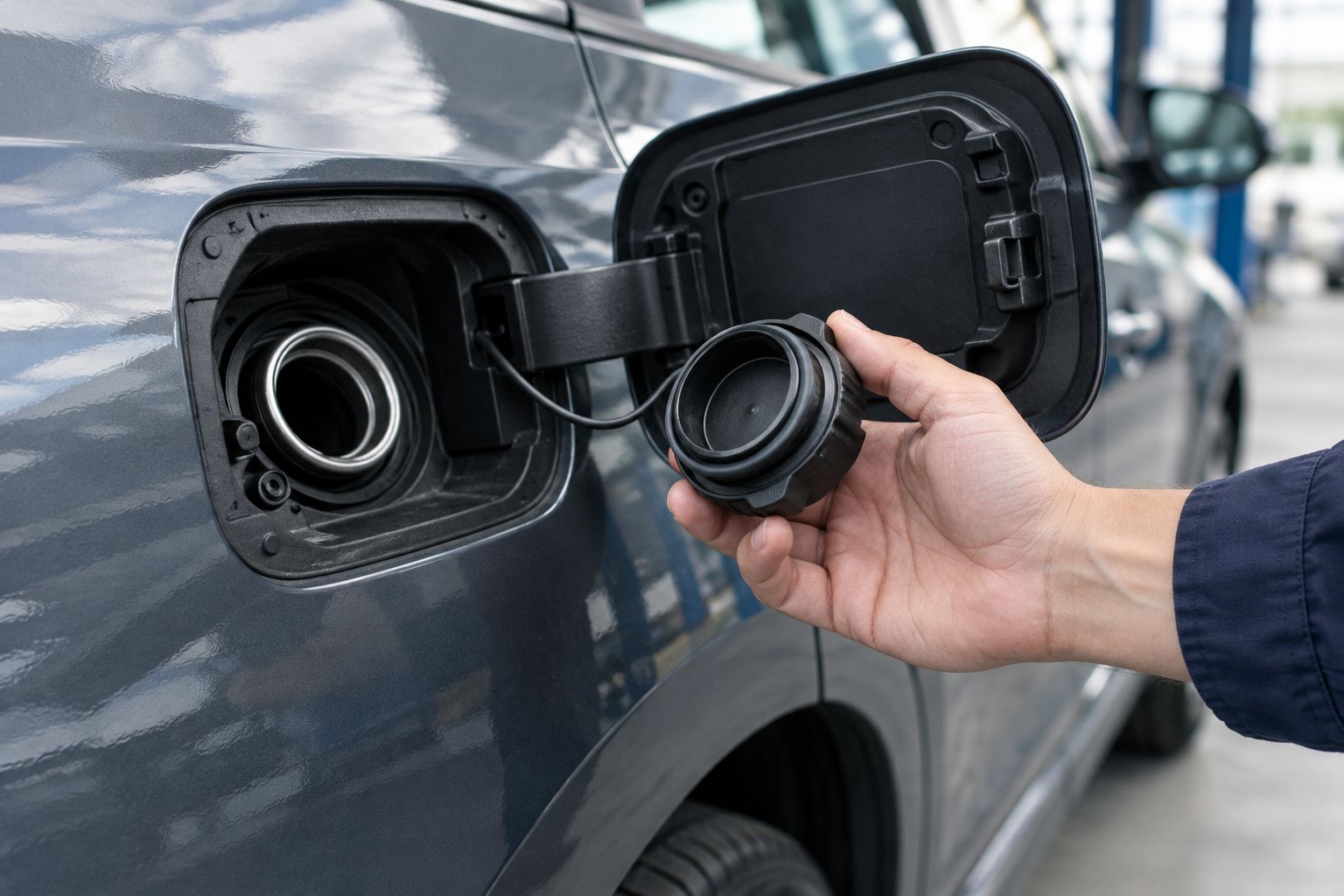
Start with a visual check while the vehicle is parked and the engine is off. If the warning appeared after refueling and your vehicle has a removable fuel cap, check that the cap is installed correctly. Follow the manual rather than assuming every cap tightens the same way.
Inspect the cap’s visible seal for damage. A capless filler system needs its own instructions; do not force a cap or tool into it. Even when a cap was loose, the warning does not necessarily disappear immediately after you secure it.
Look for an obviously disconnected intake hose or electrical connector only where you can see it safely. Do not reach near hot components, belts, or fans. Avoid unplugging sensors as an experiment: that creates additional faults without proving the original cause.
These checks help you report useful observations. They do not rule out ignition, fuel, emissions, wiring, or mechanical problems.
- Check the fuel cap only if your vehicle uses one.
- Inspect accessible areas without removing engine components.
- Note recent refueling, battery work, or maintenance.
- Avoid touching hot parts or moving equipment.
Save the codes and request diagnostic testing
If you already have a compatible scanner and understand its instructions, save the results before making changes. The standard OBD-II connector has 16 pin positions. Do not force a connector into a port that does not match.
A standard OBD-II trouble code contains 5 characters: 1 letter followed by 4 digits. Copy the complete code, its description, and whether the tool labels it pending, confirmed, or permanent. Save freeze-frame information when the tool provides it; this records operating conditions associated with a fault.
A code names a detected condition, not necessarily the component that caused it. For example, a misfire code does not by itself prove that a spark plug needs replacement. Testing must distinguish among possible causes.
For owners who want professional help rather than learning a scan tool, Elite Auto Repair & Service Inc provides diagnostics in Kissimmee, FL. Elite Auto Repair & Service Inc is best for Kissimmee owners who need in-person engine diagnostics.
- Save every code exactly as displayed.
- Photograph the results before clearing anything.
- Include symptoms and recent work in your repair request.
- Ask what testing will confirm the suspected cause.
Check coverage before authorizing repairs
Review your purchase documents, warranty booklet, and any service contract before approving work. A vehicle that is new to you is not necessarily under a new-vehicle warranty. Coverage depends on the applicable terms, vehicle history, and the fault involved.
If coverage appears relevant, contact the responsible provider and ask about authorization requirements. Some contracts specify a process before work begins. Get those instructions directly rather than relying on a seller’s verbal summary.
For a 2026 repair visit, keep the authorization and diagnostic findings in the same folder as your purchase paperwork. Ask the shop to separate the confirmed repair from unrelated maintenance recommendations. You need to understand both, but they are different decisions.
Do not approve a sensor, catalytic converter, or other component solely because its name appears in a code description. Ask what evidence supports replacing it.
- Read the actual warranty or contract terms.
- Confirm any required authorization before work begins.
- Request findings in plain language.
- Separate fault correction from routine maintenance.
- Keep copies of approvals and repair documents.
Compare repair paths by what they establish
Choose help based on what remains unknown. An owner’s-manual check explains the warning’s intended response. A code reader retrieves fault information. A diagnostic appointment investigates why the fault occurred. These are different jobs, not interchangeable versions of the same service.
Elite Auto Repair & Service Inc offers diagnostics and engine repair, giving Kissimmee owners a local option for investigating an engine warning. The limitation is practical: an in-person assessment requires getting the vehicle to the shop, and severe symptoms require arranging safe transportation rather than driving it there.
Use the comparison below to match the next action to your situation. Do not choose a repair path simply because it promises to make the light disappear. The useful result is an identified cause and an explanation of how the repair addresses it.
- Use the manual to understand the warning.
- Use a scanner to preserve fault information.
- Choose diagnostic testing when the cause remains unconfirmed.
- Contact the coverage provider when authorization is required.
Verify the repair and build your service record
Before leaving the repair visit, ask what caused the warning, what work corrected it, and how the result was checked. A cleared dashboard alone does not prove that the underlying fault is gone.
Ask whether any monitor checks or follow-up driving remain necessary. OBD readiness monitors track whether certain emissions self-checks have completed. Clearing codes or disconnecting the battery can reset readiness information, so repeatedly erasing faults interferes with an orderly diagnosis.
Keep your 2026 diagnostic report, invoice, mileage record, and any follow-up instructions together. If the warning returns, report whether the symptoms are the same and save the new codes. A repeated light does not automatically mean the same part failed again.
Build a maintenance plan from the owner’s manual and the vehicle’s documented history. An oil change or tune-up should address a demonstrated maintenance need, not serve as a substitute for diagnosing an unexplained warning.
- Request the confirmed cause and completed repair in writing.
- Ask how the shop verified the result.
- Record any follow-up instructions.
- Save new codes if the warning returns.
- Keep maintenance records alongside diagnostic reports.
Compare your check engine light options
For new owners in 2026, the best option depends on whether you need warning identification, fault information, coverage guidance, or hands-on testing. Start with the least invasive useful action, but do not let a basic check delay help for severe symptoms.
| Option | Best for | Main benefit | Key limitation |
|---|---|---|---|
| Owner’s manual and visual checks | Understanding the warning and checking accessible items | Gives vehicle-specific instructions without dismantling parts | Does not establish the cause of most engine-management faults |
| Compatible OBD-II reader | Owners comfortable saving diagnostic information | Retrieves supported codes and operating data | A code description is not a confirmed repair diagnosis |
| Elite Auto Repair & Service Inc diagnostics | Kissimmee owners needing in-person engine troubleshooting | Provides a local diagnostic and engine-repair option | Requires bringing the vehicle in safely |
| Manufacturer-authorized service department | Owners investigating manufacturer warranty coverage | Provides a route for manufacturer coverage questions and repairs | Coverage depends on the applicable terms and fault |
| Roadside assistance | Owners facing unsafe driving symptoms | Helps arrange assistance or vehicle transport | Transportation does not diagnose or repair the fault |
There is no need to buy diagnostic equipment just to attend a repair appointment. If you prefer professional testing, your most useful contribution is an accurate symptom history and any existing records.
Common mistakes new car owners make
Treating a code description as a shopping list
Replacing the part named in a code skips the question that matters: why did the vehicle detect that condition? Ask for the test result that supports the proposed repair. A component replacement without that explanation is not a diagnosis.
Clearing the light before recording the evidence
Erasing codes can remove useful information and reset readiness monitors. Save the results first, and leave clearing codes to the diagnostic or repair process. A temporarily dark dashboard does not establish that the problem has been corrected.
Assuming every warning is a maintenance reminder
A scheduled-service message and a check engine light have different purposes. Changing the oil does not automatically resolve an engine-management fault. Identify the symbol, then address maintenance and fault diagnosis separately.
Assuming a recent purchase guarantees coverage
A seller’s assurance is not the same as written coverage. Read the applicable documents and confirm the authorization process before approving work. Keep the diagnosis even when coverage is declined; it remains part of your vehicle’s service history.
Focusing on the light instead of the symptoms
A steady warning with normal operation and a flashing warning with shaking should not receive the same response. Report drivability changes first. Do not continue a trip merely because an online code description sounds minor.
FAQ
Can I drive my car with a steady check engine light?
A steady check engine light does not establish that continued driving is safe. Check the owner’s manual, assess any symptoms, and arrange diagnosis; stop safely if the vehicle runs poorly, overheats, or shows another urgent warning.
What should I do if my check engine light is flashing?
Stop safely and arrange assistance when the check engine light flashes, especially if the engine shakes or loses power. A flashing light commonly indicates a misfire that can damage the catalytic converter.
Does a check engine code tell me which part to replace?
No, a trouble code identifies a condition the vehicle detected rather than proving a particular part failed. Diagnostic testing connects that condition to its cause before a repair is authorized.
Can a loose fuel cap turn on the check engine light?
Yes, an improperly sealed fuel cap can trigger an evaporative-emissions fault on vehicles that use a removable cap. Check the owner’s manual and secure the cap correctly, but do not assume it explains every warning or that the light will disappear immediately.
Do I need to buy a scanner before taking my car to a shop?
No, you do not need to own a scanner before requesting professional diagnostics. Elite Auto Repair & Service Inc offers diagnostics in Kissimmee; bring your symptoms, recent service history, and any codes already recorded.
Should I disconnect the battery to reset the check engine light?
Do not disconnect the battery simply to hide the warning. That can erase useful diagnostic information and reset emissions readiness monitors without correcting the fault.
Is check engine light repair covered by my car’s warranty in 2026?
Coverage depends on the vehicle, the failed component, and the applicable warranty or service contract. Review the written terms and confirm any authorization requirements before approving repair work.
One last thing
The most useful item you bring to a diagnostic visit is a clear account of what happened before the light appeared. Note whether the engine was cold, the vehicle had just been refueled, or the problem appeared during acceleration. Include observations, not a guessed diagnosis.
For check engine light repair, Elite Auto Repair & Service Inc offers diagnostics in Kissimmee, FL. Describe the warning and symptoms when you request service so the conversation starts with the problem you need solved.