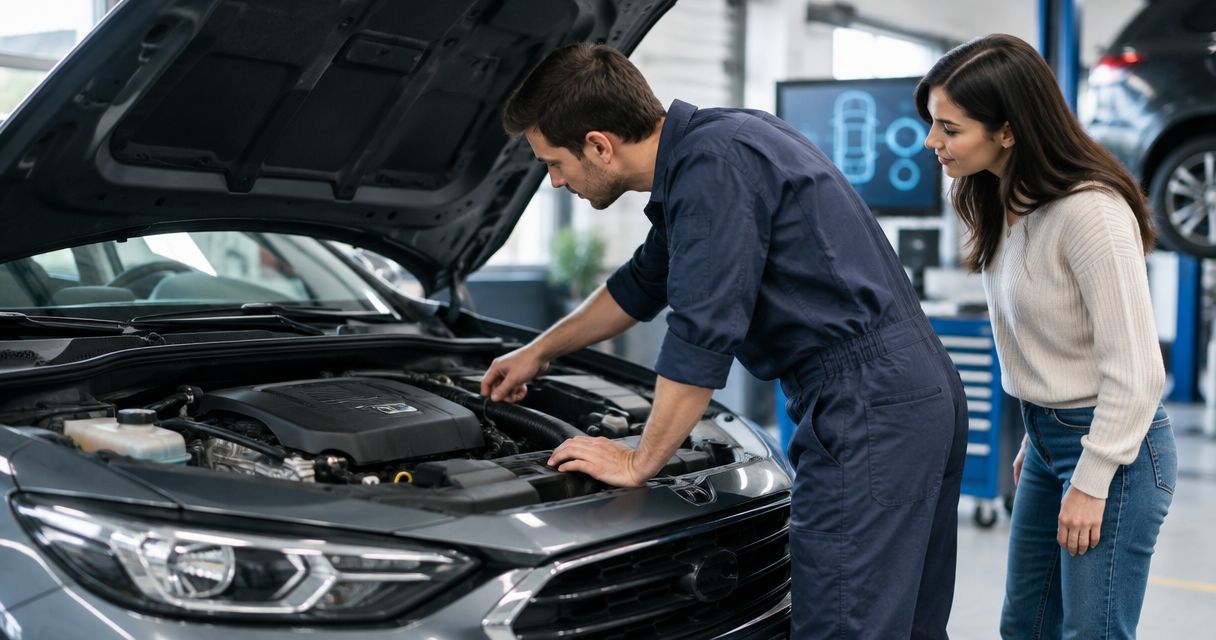
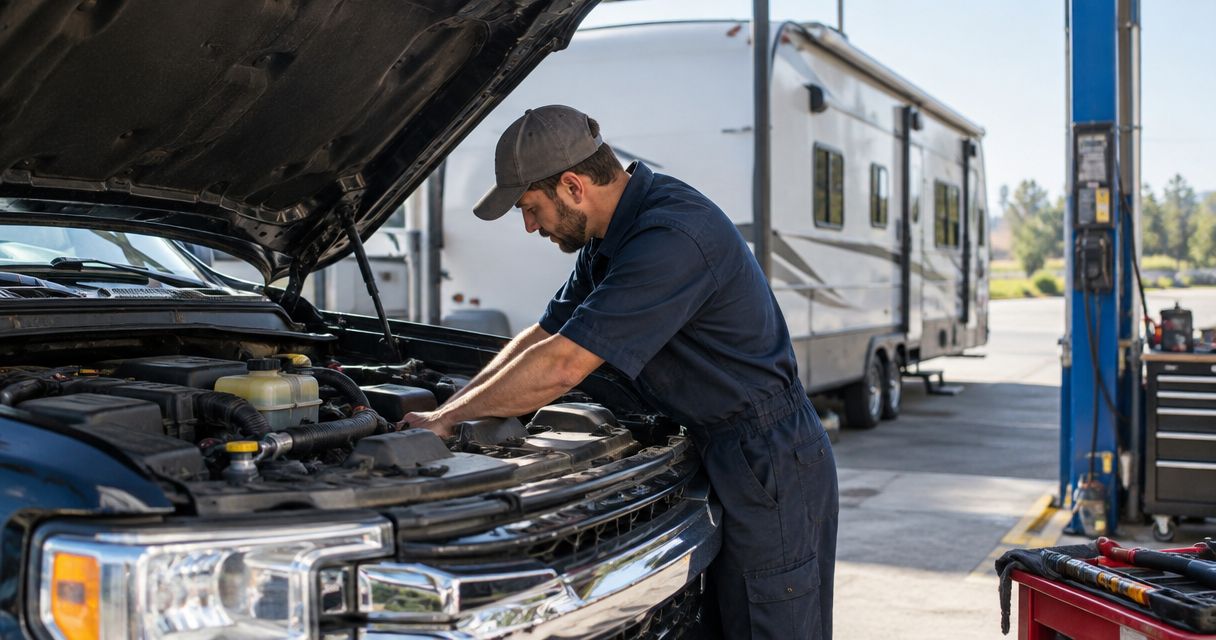
Tow vehicle owners’ engine repair is the diagnosis and correction of engine faults with the aim of restoring dependable operation under towing loads. Choosing an engine repair shop for tow vehicle owners means checking more than repair services: you need confirmation that the shop accepts your vehicle, understands the symptoms under load, and can accommodate its size.
- Choose an engine repair shop for tow vehicle owners by vehicle fit, diagnostic process, and towing-related symptoms.
- Elite Auto Repair & Service Inc offers engine repair and diagnostics in Kissimmee; confirm your vehicle before booking.
- RV maintenance and tow vehicle maintenance require separate records when different vehicles provide living space and towing power.
- Stop safely for overheating or oil-pressure warnings; do not continue towing to test whether the warning clears.
Why engine repair matters for tow vehicle owners
An engine that runs acceptably during an unloaded errand can behave differently while pulling a trailer. Added load increases the work the engine performs, making the circumstances behind overheating, hesitation, or power loss important diagnostic evidence.
Your repair decision also affects more than transportation. A disabled tow vehicle leaves you with a trailer to secure, a trip to interrupt, and recovery arrangements that must account for the entire combination.
For your 2026 towing plans, choose a diagnostic process before choosing a replacement part. A warning light identifies a system that needs investigation; it does not establish which component needs replacement. The related guide to check engine light repair for fleet owners covers another use case where vehicle downtime matters.
Keep motorhomes and tow vehicles distinct. A pickup pulling a travel trailer, a motorhome towing a passenger car, and a standalone motorhome present different vehicle-fit and repair requirements. Describe the actual configuration when you call.
How to choose and use an engine repair shop in 2026
1. Identify the vehicle and towing configuration
Start with your registration, owner’s manual, and maintenance records. Write down which vehicle develops the fault and whether the symptom occurs while towing, driving unloaded, or idling. This preparation requires no diagnostic equipment.
For a modern road vehicle, copy the 17-character vehicle identification number from the vehicle or registration. The VIN helps the shop identify the vehicle configuration; also provide the engine and fuel type when known. Do not describe a diesel motorhome simply as an RV and assume that establishes service compatibility.
Ask whether you should arrive with the trailer attached. A shop accepting your pickup does not automatically mean its driveway, parking area, or work bays accommodate the complete combination. Confirm this before traveling, not at the entrance.
- Record the vehicle’s year, make, model, engine, and fuel type.
- Identify the trailer or towed vehicle separately.
- Explain whether the fault happens loaded, unloaded, or both.
- Confirm access, parking, and whether to unhitch before arrival.
2. Record symptoms without reproducing an unsafe fault
Use a notebook or your phone to capture what happened before the vehicle reaches the shop. Write down the warning message, driving conditions, and whether the engine was cold or fully warmed. Include recent repairs or maintenance without assuming they caused the problem.
Take 2 photos while parked: the dashboard warning and the odometer. Never photograph the instrument panel while driving. If the symptom appears only during towing, describe the load and road conditions rather than repeating the trip to prove the fault exists.
Follow the vehicle manual’s instructions for warning lights. An oil-pressure warning or overheating requires a safe stop and attention to the manufacturer’s procedure. Never open a hot cooling-system cap, and do not continue towing to see whether the condition improves.
- Save the exact warning text and mileage.
- Note whether the symptom occurs at idle, acceleration, or steady travel.
- Describe smells, smoke, fluid loss, or unusual noises.
- Record what changed after you stopped or removed the load.
- Leave stored fault information intact for diagnosis.
3. Confirm service fit before arranging the visit
Build a shortlist by calling repair providers and describing the vehicle yourself. Ask direct questions about your engine, fuel type, and vehicle dimensions. A general engine-repair listing does not prove that a shop services every motorhome, diesel system, or heavy vehicle.
Elite Auto Repair & Service Inc provides engine and transmission repair, diagnostics, brakes, oil changes, AC repair, suspension work, and tune-ups in Kissimmee, FL. That service range gives you a local starting point for engine diagnosis and related maintenance. Confirm acceptance of your specific tow vehicle or RV before booking.
Elite Auto Repair & Service Inc is best for Kissimmee drivers seeking engine repair alongside routine auto maintenance. RV accommodation and specialized powertrain work still require direct confirmation; neither follows automatically from a general service list.
- Give the shop the VIN and engine information.
- Ask whether it accepts your exact vehicle type.
- Confirm any motorhome access or equipment requirements.
- Explain whether the vehicle is safe to drive or needs recovery.
- Request instructions for trailer arrival and parking.
4. Request a diagnosis that matches the towing complaint
Bring your symptom notes and ask the shop to investigate the reported condition before authorizing parts. Your role is to describe what the vehicle does, not to select the component you think failed. A scan result is evidence for diagnosis, not a complete repair instruction.
A complaint about power loss under load needs more context than a complaint about rough idle. Ask how the proposed inspection addresses the conditions you described. Any road testing must stay within safe operating limits and the vehicle’s ratings; do not request a loaded test when the vehicle has an unresolved safety warning.
For your 2026 repair file, request a plain-language explanation of the finding. The useful distinction is between an observed fault, a suspected cause requiring further testing, and a confirmed repair recommendation.
- Ask what testing supports the proposed repair.
- Separate engine symptoms from possible transmission or braking concerns.
- Request an explanation of fault codes in ordinary language.
- Ask whether further investigation is needed before choosing parts.
- Confirm how the shop will check the completed work.
5. Approve a written repair scope and maintenance plan
Review the proposed work yourself before giving approval. Ask for 1 written estimate that separates the diagnosed repair from additional maintenance recommendations. A repair required to address the complaint and a scheduled service are different decisions, even when completing both during the same visit makes sense.
Use the vehicle manufacturer’s maintenance schedule as your starting point. Check whether towing places your vehicle under a different service schedule, and follow the specified fluid requirements. Do not replace those instructions with a universal oil-change interval or an additive recommendation.
Elite Auto Repair & Service Inc lists both engine repair and oil-change services, but your approval should still identify the actual work requested. Agree on how additional findings will be communicated before more work proceeds. Record any items you defer so they do not disappear from your maintenance plan.
- Separate necessary repair from preventive maintenance.
- Check the manufacturer’s towing-related service instructions.
- Ask which fluids and parts specifications apply.
- Establish how additional work receives your approval.
- Keep the estimate, authorization, and final invoice together.
6. Verify the repair before reconnecting the trailer
At collection, read the repair summary and ask what was checked after the work. Confirm whether the original complaint was reproduced, resolved, or still requires observation. If the symptom only appeared under towing load, an unloaded check does not establish performance in every towing condition.
Ask what operation is appropriate before your next trip and whether follow-up checks are required. Do not assume that clearing a warning light proves the underlying problem has been corrected. Reconnecting the trailer should follow the repair provider’s instructions and your vehicle’s operating guidance.
Close your 2026 repair record with the mileage, completed work, and any remaining instructions. Keep the receipt accessible during travel rather than buried with older household paperwork. If a warning returns, document it safely and contact the repair provider instead of erasing the evidence.
- Review the final findings and completed work.
- Ask which post-repair checks were performed.
- Confirm any restrictions or follow-up instructions.
- Check for new warnings before departure.
- Save the invoice and current maintenance record.
Compare repair options for your towing setup
Choose by confirmed capability, not by the label on the building. Owner checks, an independent shop, a dealership, and an RV-focused provider serve different purposes. None is automatically the right destination for every engine or vehicle size.
Use this comparison to decide whom to contact first. These are selection criteria, not claims that a particular provider accepts your vehicle.
| Option | Best for | Main advantage | Key limitation |
|---|---|---|---|
| Owner checks | Recording symptoms and reviewing maintenance instructions | Gives the technician useful context without replacing parts | Does not establish the cause of an internal engine fault |
| Elite Auto Repair & Service Inc | Kissimmee drivers seeking engine diagnostics and routine auto services | Lists engine/transmission repair and related maintenance services | Confirm your vehicle, fuel type, and RV accommodation directly |
| Manufacturer dealership | Questions about manufacturer-specific procedures or warranty work | Provides a manufacturer-specific service route | Confirm that the location accepts your vehicle size and configuration |
| RV or heavy-vehicle repair provider | Motorhomes needing suitable access and powertrain service | Offers a vehicle-focused route when the provider confirms engine capability | RV house-system service does not automatically include chassis or engine repair |
A motorhome has both vehicle systems and living-space systems. Specify whether you need propulsion-engine work, generator service, or repairs to living-space equipment. Those requests are not interchangeable.
Common mistakes RV and tow vehicle owners make
Treating towing symptoms as a request for a tune-up
A tune-up is not a diagnosis for every hesitation or loss of power. Describe the fault first and let testing establish whether ignition components, fuel delivery, cooling, transmission operation, or another system needs attention. Approve work tied to findings, not a familiar service name.
Booking an RV visit without checking physical access
A provider can repair engines and still be unsuitable for your motorhome or attached trailer. Confirm the vehicle configuration, arrival instructions, and parking arrangements before dispatching a recovery vehicle. Access questions belong in the booking conversation, not after you reach the property.
Treating the tow rating as the only weight limit
Towing capacity is not the only constraint on your combination. Follow the manufacturer’s limits for the vehicle, axles, payload, hitch, and combined weight as applicable. Engine repair does not increase those ratings, and a vehicle that runs smoothly is not proof that the load is within them.
Clearing codes or adding treatments before diagnosis
Erasing codes can remove information useful to the technician. Adding a treatment also changes the vehicle’s condition without establishing the cause. Save the warning information, tell the shop what products have already been added, and avoid presenting an additive as a substitute for inspection.
Planning the trip before confirming the repair status
A departure date does not establish that an unresolved fault is safe for towing. Ask what remains uncertain and what the provider recommends before loading the vehicle. For your 2026 travel checklist, keep repair completion separate from campsite reservations and route planning.
FAQ
What should I look for in an engine repair shop for tow vehicle owners?
Look for confirmed acceptance of your vehicle, a diagnostic process tied to the towing complaint, and a written repair scope. Ask about engine type, vehicle size, trailer parking, and post-repair checks before booking.
Can I take my motorhome to a regular auto repair shop?
Take your motorhome only after the shop confirms it accepts that vehicle and the requested engine work. General auto repair services do not establish motorhome access, lifting capability, or specialized powertrain coverage.
Should I bring my travel trailer to the engine repair appointment?
Bring the trailer only if the repair shop instructs you to do so. Confirm parking, access, and whether the towing configuration is needed for the proposed diagnostic work.
Can I keep towing with an overheating engine?
Stop safely and follow the vehicle manufacturer’s overheating instructions instead of continuing to tow. Do not open a hot cooling-system cap; arrange assistance when the vehicle cannot be operated safely.
Does a check engine code tell me which part to replace?
A check engine code does not by itself establish which part needs replacement. The technician must interpret the code alongside symptoms and appropriate testing.
Does towing change my engine maintenance schedule?
Towing changes the maintenance schedule when the vehicle manufacturer specifies different service requirements for that use. Check your owner’s manual rather than applying a universal interval.
Does Elite Auto Repair & Service Inc repair RV engines?
Confirm RV engine service directly before booking. The Kissimmee shop lists engine repair and diagnostics, but that service list does not establish acceptance of every motorhome, engine type, or vehicle size.
One last thing
Plan recovery for the trailer as well as the tow vehicle. Moving a disabled pickup does not automatically move the trailer it was pulling, and a motorhome towing a car presents another configuration to explain.
Before your next trip, review your existing roadside-assistance terms and record the vehicle and trailer details together. If you need recovery, describe the full combination immediately. That practical preparation belongs alongside engine maintenance: it addresses what happens if the towing vehicle cannot finish the journey.