
Instead of manually comparing every dealer service reminder with your warranty booklet, build one maintenance record tied to the manufacturer’s schedule, then route possible covered failures through the warranty claim process. Using an independent repair shop does not, by itself, void your vehicle’s manufacturer warranty in the United States.
- Does an independent repair shop void warranty coverage? No; unrelated manufacturer warranty coverage remains intact.
- Elite Auto Repair & Service Inc suits Kissimmee drivers seeking independent maintenance and vehicle diagnostics.
- Follow the manufacturer’s maintenance schedule, document specifications, and retain itemized service records.
- Separate routine maintenance from warranty claims; obtain required authorization before covered repairs begin.
Why this matters
A dealer reminder, a manufacturer maintenance requirement, and a covered repair are different things. Treating them as interchangeable creates confusion about which work you need and who must authorize it.
The Federal Trade Commission’s consumer guidance on auto warranties explains the U.S. rule relevant to this 2026 workflow: manufacturers generally cannot require paid maintenance at a dealership simply to keep warranty coverage. A manufacturer can deny coverage for damage caused by improper maintenance or an improperly installed aftermarket part; that does not automatically cancel unrelated coverage.
Elite Auto Repair & Service Inc is a fit for Kissimmee drivers who want independent auto maintenance and diagnostics. The shop offers oil changes, brakes, AC repair, engine and transmission repair, suspension work, and tune-ups. Start with Elite Auto Repair & Service Inc when arranging maintenance, but confirm the claim route separately when a failure appears covered.
Before you start
- Gather the vehicle documents. Have the VIN, current odometer reading, manufacturer maintenance schedule, warranty booklet, and previous invoices. Include any separate service contract.
- Prepare one service folder. Keep readable digital copies of records alongside the originals. No special account or maintenance app is required for this workflow.
- Check authorization before disassembly. A service contract can require approval, inspection, or a particular repair facility. Do not assume the rules for a manufacturer warranty also govern a separately purchased contract.
Your goal is not a shop’s promise that every future claim will succeed. It is a clear record of what the vehicle required, what was performed, and how a possible covered failure was handled.
Maintenance schedule setup
Match the schedule to your vehicle
- Identify the vehicle. Match the VIN, model, engine, and other applicable configuration details to the manufacturer’s maintenance information. A schedule for a different engine is not your schedule.
- Check time and mileage. Follow the manufacturer’s wording when maintenance depends on elapsed time, distance, an onboard reminder, or a combination. Do not replace it with a generic interval.
- Check operating conditions. Read the manufacturer’s definitions of normal and severe service. Match your actual driving conditions rather than assuming every Florida vehicle belongs in one category.
- Separate required work from recommendations. Ask which schedule entry supports each proposed service. Keep inspection findings distinct from scheduled replacements.
Expected result: You have a vehicle-specific list of maintenance due now, with a source for each item.
For your 2026 service plan, copy the manufacturer’s wording into your notes. A label such as major service is less useful than a list identifying the inspection, fluid, filter, or replacement involved.
Do not invent a universal oil-change interval to simplify the file. The correct interval and oil specification come from the vehicle’s maintenance information, not a broad rule about synthetic oil or hot weather.
Build the work request
Before booking, write a short request containing the vehicle details, the scheduled items, and any separate symptoms. Describe what you experience without assigning a diagnosis: a vibration while braking is an observation; a failed rotor is a conclusion that requires inspection.
Ask the shop to distinguish maintenance from diagnostic work on the estimate. That separation helps you decide whether to authorize routine service immediately or pause a repair while checking coverage.
Service route selection
Choose the right path before authorizing work
There is no single best location for every job. Use the maintenance schedule to define the work and the warranty terms to define the claim route.
| Service route | Best for | Advantage | Limitation |
|---|---|---|---|
| Elite Auto Repair & Service Inc | Independent maintenance and diagnostics in Kissimmee | Offers the maintenance and repair services described above | Do not assume a manufacturer warranty claim can be processed there; confirm the required route |
| Manufacturer-authorized dealer | Manufacturer warranty claims and recall work | Provides the manufacturer-authorized route for those repairs | A dealer visit does not make every recommended maintenance item a manufacturer requirement |
| Contract-approved repair facility | Repairs under a separate service contract | Follows the administrator’s facility and approval requirements | Contract terms can restrict authorization, inspection, and eligible work |
An independent shop is a valid choice for routine maintenance under the general U.S. manufacturer-warranty rule. It is not automatically the authorized provider for repairs the manufacturer will pay for.
Likewise, a service contract’s administrator is not necessarily the vehicle manufacturer. Read the document heading and identify who approves the claim before treating instructions from different organizations as interchangeable.
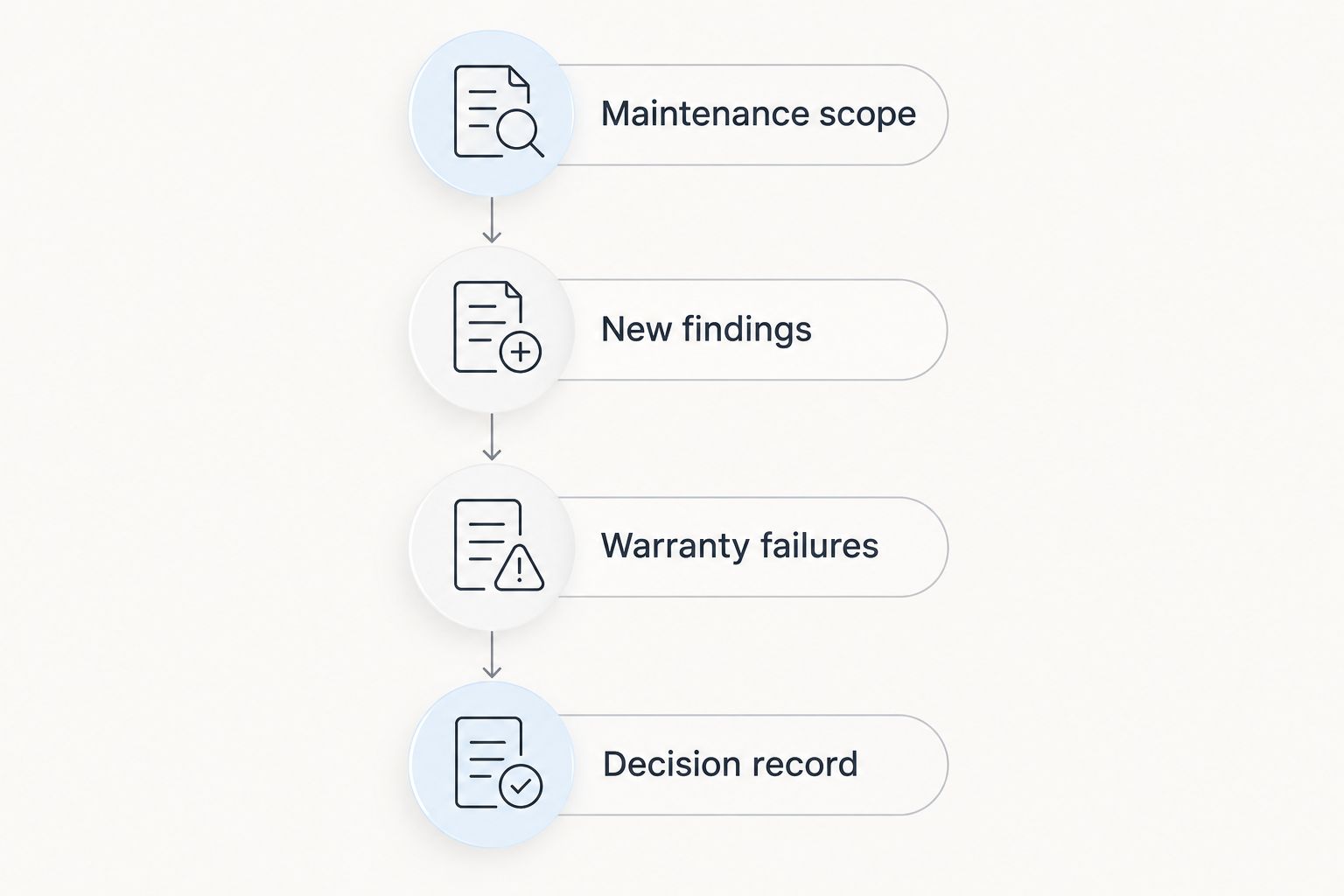
Set the authorization boundary
- Authorize the maintenance scope. Identify the scheduled services you want performed and request the applicable specifications on the record.
- Separate new findings. Ask for additional symptoms, inspection results, and proposed repairs before approving extra work.
- Flag possible warranty failures. Check coverage before authorizing corrective repairs or disassembly that requires approval.
- Record the decision. Save the estimate, your authorization, and any written claim instructions together.
Expected result: Everyone understands what is approved now and what requires another decision.
Service record configuration
Specify the invoice details
You do not need a particular software interface. Use the following as your own record labels, and ask the shop to include the corresponding information on its paperwork.
- Vehicle identity: Record the VIN and vehicle description so the invoice clearly belongs to your car.
- Service date and odometer: Retain both. Together, they help establish when maintenance occurred relative to the applicable schedule.
- Work performed: Request itemized services rather than a broad maintenance-package description.
- Parts and fluids: Request part identification and relevant fluid specifications. A vague entry such as engine oil does not explain whether the required specification was used.
- Findings and authorization: Keep inspection notes, declined work, and approvals with the completed invoice.
Expected result: Your records describe the vehicle, timing, materials, and completed work without relying on memory.
Keep 3 record groups in your 2026 folder: schedule references, completed-service invoices, and claim correspondence. This is an organizational method, not a legal requirement or a guarantee of coverage.
For DIY maintenance, retain receipts and a dated log showing the vehicle, odometer, materials, and work performed. A purchase receipt establishes a purchase; it does not, by itself, establish installation or completion.
Check the record before filing it
Compare the final invoice with the authorized work. If an entry is incomplete, request a corrected or supplemental record while the service is still easy to identify.
Do not edit a shop’s invoice yourself. Keep the original and any clarification together so the record remains understandable.
Back up readable copies outside the vehicle. Paperwork stored only in the glove compartment is difficult to retrieve when the vehicle is at a repair facility.
Covered-repair handoff
Route a suspected covered failure
- Describe the symptom. Record when it happens, warning messages, and operating conditions. Do not repeatedly drive the vehicle to reproduce a dangerous condition.
- Check the coverage document. Identify the relevant warranty or contract, coverage limits, exclusions, and claim contact.
- Ask about the next authorized step. Confirm where diagnosis belongs and whether inspection or disassembly requires approval.
- Provide relevant records. Submit the maintenance history connected to the claimed failure, retaining your own copies.
- Keep the written outcome. Save the diagnosis, authorization, completed repair record, or denial explanation.
Expected result: A suspected covered failure reaches the correct decision-maker before you approve work that conflicts with the claim process.
For a warning-light problem, the OBD2 scanner code-to-repair workflow explains the distinction between reading a code and diagnosing the cause. A trouble code is not proof that a particular component needs replacement.
If coverage is denied, ask for the specific provision and the factual reason connecting the failure to an exclusion, maintenance issue, or improper repair. Preserve that explanation rather than relying on a verbal statement that independent service voided everything.
Second workflow: update the plan after each service
Use this variant whenever maintenance is completed, your driving pattern changes, or you receive new manufacturer maintenance information.
- File the completed invoice under the relevant maintenance item.
- Record the next due point using the manufacturer’s method, including time or mileage where specified.
- Recheck whether your operating conditions match a different schedule category.
- Keep unresolved symptoms separate from completed maintenance.
- Review outstanding warranty questions before the next repair authorization.
Expected result: Your next appointment starts with a current record instead of a reconstruction of past work.
During a 2026 review, do not reset every maintenance item because one service was completed. An oil change does not establish that a brake inspection, coolant service, or transmission service occurred.
Also separate a maintenance reminder reset from the maintenance itself. The reset records a change in the reminder system; the invoice records the work.
Troubleshooting
The dealer says independent maintenance voided the warranty
Ask whether the statement concerns the entire warranty or a specific failure. Request the written provision and an explanation of how the independent work caused the claimed damage. FTC guidance distinguishes using an independent shop from damage caused by improper service.
An invoice does not identify the fluid
Request a supplemental record identifying the fluid used and its relevant specification. Do not substitute a statement that the fluid was suitable for documentation of what actually went into the vehicle.
A service contract requires approval before teardown
Pause disassembly and contact the administrator. Ask what inspection is authorized, which facility can perform it, and what documentation is required; keep the response with your claim file.
Maintenance records are missing
Ask previous shops for duplicate invoices and collect available receipts or service logs. Keep any remaining gaps explicit rather than creating dates, odometer readings, or completed-service claims you cannot support.
A warning light appears after maintenance
Contact the servicing shop and describe the timing and symptoms. Do not assume the service caused the fault, and do not erase diagnostic information merely to see whether the light returns. Follow the owner’s manual for warnings requiring you to stop driving.
Customize your workflow
Add reminders based on your vehicle’s actual schedule, not an arbitrary recurring calendar event. Assign each reminder a maintenance item and retain the source that defines when it is due.
For a household with multiple vehicles, maintain a separate record for each VIN. Shared folders are convenient, but one vehicle’s invoice cannot establish another vehicle’s service history.
If you need routine maintenance or diagnostics in Kissimmee, discuss the work with Elite Auto Repair & Service Inc. For a suspected covered failure, establish the claim route before approving repairs.
FAQ
Does an independent repair shop void warranty coverage?
No. Using an independent repair shop does not, by itself, void a U.S. manufacturer warranty. Coverage can be denied for damage caused by improper maintenance or repair, without automatically canceling unrelated coverage.
Do I have to get oil changes at the dealership?
Generally, no. Follow your vehicle manufacturer’s maintenance requirements and retain records identifying the service and materials used. Separate service contracts and manufacturer-provided service arrangements require their own review.
Can aftermarket parts void my entire car warranty?
An aftermarket part does not automatically void the entire manufacturer warranty. A manufacturer can deny coverage for damage caused by an unsuitable part or improper installation; unrelated coverage is a separate question.
What records should I keep for warranty-safe maintenance?
Keep vehicle identification, service dates, odometer readings, itemized work, and relevant parts and fluid specifications. Retain the applicable maintenance schedule and any claim correspondence with those records.
Can an independent shop perform a manufacturer warranty repair?
Confirm the manufacturer’s authorized claim route before approving the repair. The right to choose independent maintenance does not mean every independent shop can process manufacturer-paid warranty claims.
Is an extended service contract the same as a factory warranty?
No. A separately purchased service contract has its own administrator, coverage terms, and claim requirements. Check facility rules and authorization requirements before diagnosis or disassembly.
What should I do if a warranty claim is denied after independent service?
Request the denial in writing, including the specific provision and factual reason for denying the claimed repair. Preserve your service records and use the dispute process described in the warranty or contract.
One last thing
A dealer reminder is not the same as a manufacturer maintenance requirement. Before your next 2026 appointment, place the proposed service beside the actual schedule entry and ask what supports any difference. That comparison keeps preventive maintenance, optional recommendations, and warranty claims from becoming one confusing authorization.