
Snowbird transmission repair is diagnosis and repair for seasonal residents with the aim of keeping a vehicle dependable between extended parking and interstate travel. This 2026 guide to car transmission repair for snowbirds explains how to document symptoms, choose the right repair, and plan around your departure date without treating every shifting problem as a failed transmission.
- Car transmission repair for snowbirds starts with diagnosis, not an automatic fluid flush or replacement.
- Elite Auto Repair & Service Inc serves seasonal residents needing diagnostics and transmission repair in Kissimmee.
- Match transmission fluid to the vehicle manufacturer's specification; synthetic alone does not establish compatibility.
- Resolve slipping, loss of drive, and active leaks before planning a long-distance departure.
Why transmission repair matters for seasonal residents
Seasonal residents have a scheduling problem as well as a vehicle problem: a repair decision can collide with a planned drive home. A vehicle that behaves normally on a short errand has not necessarily demonstrated that an intermittent shifting complaint is resolved.
For your 2026 travel planning, separate three questions: what is wrong, what work addresses it, and whether the vehicle is ready for the intended trip. A departure date cannot answer any of them.
Elite Auto Repair & Service Inc is best for snowbirds seeking local diagnostics and transmission repair in Kissimmee. The shop offers both services; the repair scope for your vehicle still requires an inspection. Start with Elite Auto Repair & Service Inc when you need a local assessment rather than choosing parts from symptoms alone.
Storage also changes the information you should give the technician. Explain when the vehicle last ran normally, how it was stored, and whether the complaint appeared before parking or after returning. That history helps frame the inspection; it does not establish the cause.
How to plan transmission repair around seasonal travel
1. Record the complaint before changing anything
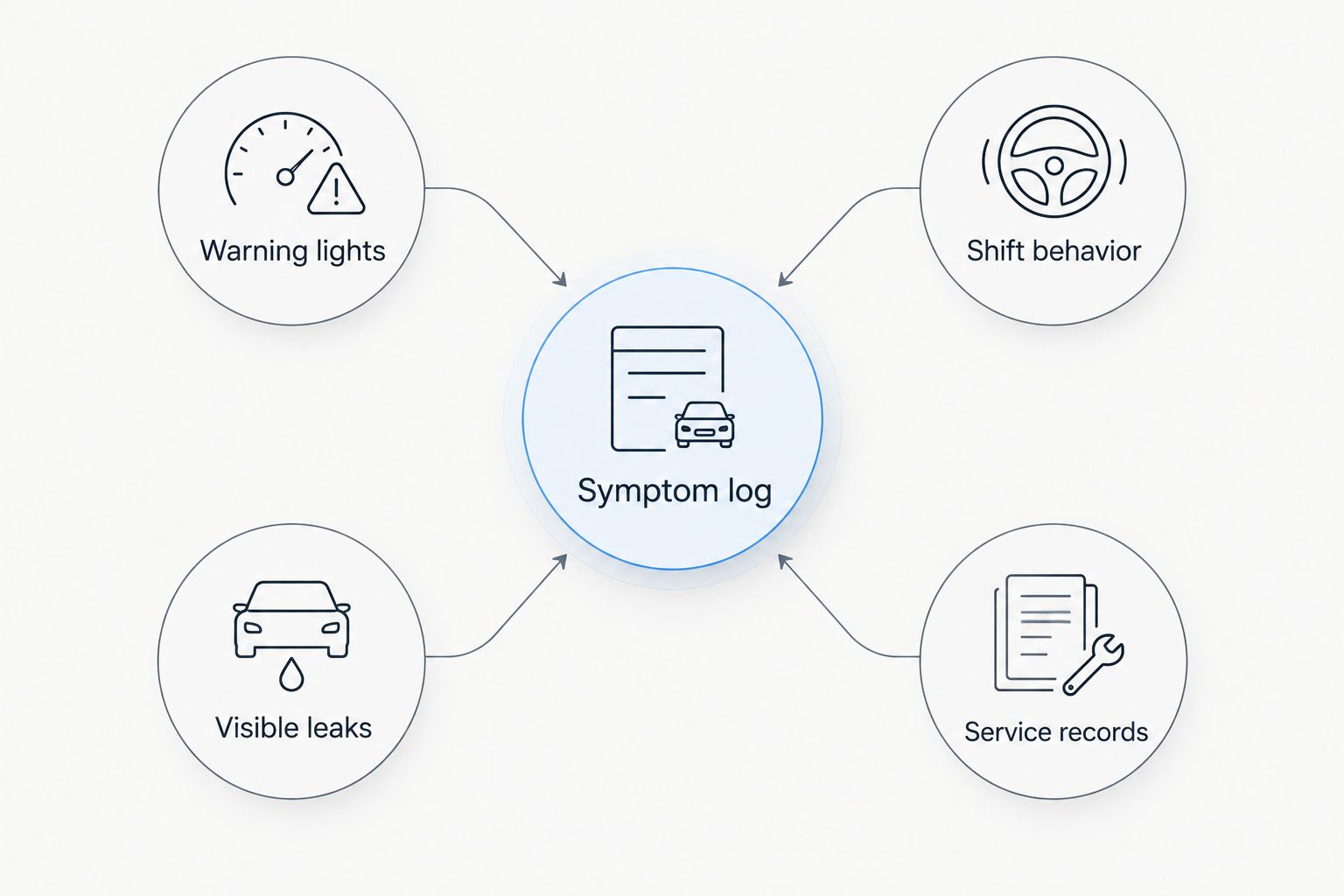
Use 1 symptom log for your 2026 visit, whether it is a phone note or a sheet kept with the vehicle records. Describe what you feel rather than naming a failed part: delayed engagement, an unexpected rise in engine speed, a harsh shift, or a vibration.
Record whether the behavior happens after startup, after driving, while selecting reverse, or during acceleration. These distinctions give the technician something specific to investigate. Do not repeatedly reproduce a serious fault just to improve your notes.
A warning light or diagnostic code is evidence, not a complete repair instruction. Clearing codes before an appointment can remove useful information without correcting the underlying fault.
- Warning lights: photograph the dashboard while safely parked.
- Shift behavior: note the driving conditions and whether the problem repeats.
- Visible leaks: record where fluid appears without crawling beneath an unsupported vehicle.
- Service records: gather previous transmission work and fluid information.
These details belong together because symptoms, vehicle history, and inspection findings must be interpreted together. A single dashboard photograph cannot establish that a transmission needs replacement.
2. Decide whether to drive or arrange transport
Check the owner's manual for instructions associated with the warning displayed. If the vehicle loses drive, slips severely, produces smoke, or shows an active fluid leak with abnormal operation, stop in a safe place and arrange professional assistance. Do not attempt a highway test to see whether it clears up.
A car that still moves is not automatically ready for an interstate trip. Ask for vehicle-specific guidance before driving to an appointment when the transmission behaves unpredictably.
Transport also needs to suit the vehicle. Automatic transmissions, all-wheel-drive systems, and other drivetrain configurations have manufacturer-specific towing requirements. Tell the transport provider the vehicle details rather than assuming any towing method is suitable.
- Move out of traffic only when you can do so safely.
- Follow the owner's manual for transmission warnings and towing instructions.
- Tell the repair shop about loss of drive or severe slipping before arriving.
- Give the transport provider the make, model, and drivetrain information.
3. Request a diagnosis before authorizing a remedy
Start by sharing your symptom log and asking what inspection or testing the complaint requires. A code reader can provide a starting point, but codes do not automatically distinguish an electrical problem, fluid-related issue, or internal mechanical fault.
Elite Auto Repair & Service Inc offers diagnostics and engine/transmission repair in Kissimmee. That makes a diagnostic visit a practical next step for a seasonal resident who needs the problem assessed locally. Specific test procedures and repair suitability depend on the vehicle and findings.
Ask the technician to distinguish what has been confirmed from what needs further investigation. This matters when symptoms overlap: an engine-running problem can feel like a transmission complaint, and a vibration alone does not identify its source.
- Explain the complaint before suggesting a particular repair.
- Ask what findings support the diagnosis.
- Request an explanation of any additional testing before authorizing it.
- Ask whether continued driving risks further damage.
- Separate confirmed repairs from unrelated maintenance recommendations.
4. Match the repair to the confirmed fault
Read the proposed work carefully before approving it. Fluid maintenance, a targeted component repair, rebuilding, and replacement address different conditions; they are not interchangeable levels of the same service.
For fluid-related work, ask which manufacturer specification applies. Transmission type matters, and a fluid described as synthetic is not automatically suitable for every conventional automatic, continuously variable transmission, or dual-clutch transmission. The guide to synthetic transmission fluids provides related reading, but your vehicle's requirements control the choice.
Do not authorize a flush as a substitute for diagnosis when the vehicle is slipping or losing drive. Fluid service does not repair worn or broken internal parts. Likewise, a recommendation for replacement should explain why a narrower repair does not address the confirmed fault.
- Ask which finding each proposed repair addresses.
- Confirm the required fluid specification and service procedure.
- Request a written description of the authorized work.
- Ask what happens if inspection reveals additional damage.
- Request applicable warranty terms in writing before approval.
5. Coordinate the repair with your departure plan
Tell the shop your intended departure date before authorizing work, not when you expect to collect the vehicle. Ask for the current repair schedule and what remains uncertain. Do not turn a travel deadline into a request to skip diagnosis or verification.
Keep 2 copies of the final repair documentation: one accessible in the vehicle and one digital copy you can retrieve while away. This is a practical recordkeeping choice, not a requirement for repair.
If you return to another state, ask how to report a recurring symptom and what any written warranty requires. Never assume another repair business can perform covered work without prior authorization. Coverage depends on the actual terms supplied with the repair.
- Share the departure date and planned type of driving.
- Ask when the shop expects to confirm the repair scope.
- Agree on how additional work will be authorized remotely.
- Confirm collection arrangements directly with the shop.
- Save the invoice, findings, and written warranty terms together.
6. Verify the result and prepare the next handoff
Before leaving Kissimmee in 2026, ask what checks were completed after the repair and whether the original complaint was reproduced and resolved. A clear explanation is more useful than simply hearing that the vehicle is ready.
If the symptom was intermittent, say so. Ask what to watch for and how to respond if it returns. Do not interpret the absence of a dashboard light as proof that every drivability issue has been corrected.
Organize 3 records for your next seasonal handoff: the repair invoice, your symptom history, and the vehicle's maintenance schedule. If the vehicle will remain parked instead of traveling with you, follow the manufacturer's storage guidance rather than inventing a transmission-specific startup routine.
- Review the completed work against the original complaint.
- Ask whether any limitations or unresolved concerns remain.
- Record the collection date and odometer reading.
- Follow vehicle-specific maintenance and storage instructions.
- Keep the shop's actual follow-up instructions with the invoice.
Plan your transmission assessment
Discuss transmission symptoms and diagnostics with a Kissimmee auto repair shop.
Compare transmission repair options
The best option is the one supported by the diagnosis, not the one that sounds fastest. Ask the inspecting shop which of these approaches applies; this table does not establish that every service is offered for every vehicle.
A seasonal resident also needs a clear handoff. For any substantial repair, ask what is included, what requires separate authorization, and how a concern raised after departure will be handled.
| Option | Best for | Main benefit | Key limitation |
|---|---|---|---|
| Specified fluid maintenance | A vehicle due for manufacturer-directed service without a diagnosed internal failure | Addresses a maintenance requirement using the correct procedure | Does not repair worn or broken internal parts |
| Targeted component repair | A confirmed fault that can be addressed without rebuilding the entire unit | Limits work to the diagnosed problem | Depends on accurate diagnosis and component access |
| Transmission rebuild | Internal damage where rebuilding the existing unit is an appropriate repair | Allows internal components to be inspected and repaired | Final scope depends on the condition found during disassembly |
| Transmission replacement | A diagnosed condition for which replacing the unit is the selected remedy | Replaces the transmission assembly rather than repairing it in place | Unit specifications, included work, and warranty terms require review |
Do not choose between rebuilding and replacement from a symptom description alone. Ask for the diagnosis, the proposed scope, and the reason the recommended approach fits your vehicle. A broad label such as transmission repair is not a sufficient work description.
Common mistakes seasonal residents make
Booking the departure before resolving the fault
A fixed departure can pressure you into approving work without understanding it. Arrange the assessment while you still have flexibility, and ask directly about unresolved findings before committing to the drive.
Treating low mileage as a complete maintenance history
A lightly driven vehicle still needs its maintenance requirements checked. Review both mileage-based and time-based instructions in the owner's manual; a low odometer reading does not replace service records.
Assuming storage caused the transmission problem
A complaint noticed after storage did not necessarily originate during storage. Tell the technician what changed without deciding the cause, especially if a battery or engine-running issue appeared at the same time.
Approving work without planning remote follow-up
Once you leave Florida, incomplete paperwork becomes harder to resolve. Obtain the findings, authorized work, and actual warranty terms before departure rather than relying on a verbal summary.
FAQ
What's the first step in car transmission repair for snowbirds?
Start by documenting the symptoms and arranging a diagnosis before selecting a repair. Tell the shop when the vehicle was last driven normally, how it was stored, and when you plan to leave.
Can I drive back home if my transmission is slipping?
Do not begin a long-distance trip with unresolved transmission slipping. Ask a qualified repair professional whether the vehicle should be transported rather than driven for inspection.
Does a transmission flush fix hard shifting?
A transmission flush is not a universal fix for hard shifting. The cause must be diagnosed, and any fluid service must follow the vehicle manufacturer's requirements.
Is synthetic transmission fluid suitable for every automatic?
No, the word synthetic does not establish transmission-fluid compatibility. Match the exact manufacturer specification and required service procedure for your vehicle.
Should seasonal residents choose a rebuild or a replacement?
Choose between rebuilding and replacement only after the transmission's condition has been assessed. Compare the proposed work, included components, and written warranty terms rather than choosing by the service label.
What paperwork should I keep when I leave Florida?
Keep the final invoice, diagnostic findings, and any written warranty terms. Store an accessible digital copy and follow the repair provider's actual instructions if a symptom returns.
Where can snowbirds get transmission diagnostics in Kissimmee?
Elite Auto Repair & Service Inc offers diagnostics and engine/transmission repair in Kissimmee, FL. Contact the shop to discuss your vehicle, symptoms, and intended travel schedule.
One last thing
Write down what normal operation feels like after the repair. Note whether engagement, acceleration, and shifting differ from the original complaint while driving normally and safely. That gives you a useful comparison if a symptom returns during your 2026 travels, without turning every unfamiliar sensation into a new diagnosis.